Digital reader
The TrueScale Playbook™
A Practical Executive Guide to Scaling Without Breaking
Rubin Stovall
Introduction
Growth changes how you have to lead.
Most people describe growth as proof that a company is working. More customers. A bigger team. Rising revenue. New opportunities. From the outside, the story looks positive.
But inside the business, it can feel very different. Decisions take longer. Good people spend more time coordinating work than completing it. Leaders who once had a clear view of the operation start relying on partial information. The company is growing. But it's getting harder to run.
I wrote The TrueScale Playbook™ to help executives work through that tension. My perspective comes from more than 20 years in leadership, including American Express, MDLIVE, and Thirty Madison/Nurx. Across that career, the operating question has stayed remarkably consistent: what does the organization need now that the old way of working can no longer carry the load?
I've watched that question play out in a support organization that had to grow its team faster than it could grow its managers. I've watched it in a telehealth operation where the customer promise depended on coordination across clinical, technical, and service teams that didn't share a common operating rhythm. And I've watched it in larger, more mature environments where the systems existed but had quietly stopped matching how the work actually got done.
The answer changes as the company changes. A founder's accessibility can help a small team move quickly. Later, that same accessibility turns into a decision queue. A dependable employee becomes a manager because everyone trusts that person to get things done. But the new role requires a different system: clear expectations, useful measures, decision authority, coaching, and support. Informal knowledge keeps work moving when everyone knows one another. It becomes a risk when the work spreads across teams, locations, or technologies.
Growth doesn't just add work. It changes how you have to lead. Early on, you can solve a lot through judgment, proximity, and effort. You hear what customers are saying. You make decisions in real time. You step in and correct mistakes yourself. As the organization expands, those habits stop scaling. Your job shifts from rescuing the work to building a system that helps people do good work consistently.
Here's the thing: operational strain rarely arrives as one dramatic event. It shows up as a series of reasonable responses to immediate problems. You add a meeting because people are misaligned. Someone creates a spreadsheet because the system doesn't show what a manager needs. A senior leader keeps one more category of approval — refunds, credits, exceptions — because the team isn't ready to own it. A high performer trains every new hire because the onboarding process is incomplete.
Each response makes sense on its own. Together, they create an organization that needs extra effort to produce ordinary results. I call that accumulation operational debt.
Operational debt works a lot like financial debt. You solve today's need and postpone part of the cost. Some of that is unavoidable. Every growing company improvises. The trouble starts when the temporary workaround becomes the permanent way the business runs. Then you start paying interest through rework, slow decisions, inconsistent customer experiences, exhausted managers, and capacity you can't use.
This playbook will help you see that debt before it starts to feel normal. We'll begin with why growing companies break. Then we'll use the five stages of operational maturity to locate the organization as it actually operates today. From there, we'll work through the TrueScale Method™: Assess → Stabilize → Scale → Accelerate.
The sequence matters. You can't stabilize what you haven't examined. You shouldn't scale a process that produces inconsistent results. And you shouldn't accelerate through technology or AI until the work, ownership, and controls underneath it are clear. I've seen organizations buy new tools to fix problems that were never tool problems. The software worked. The system around it didn't.
I've kept the chapters practical. You'll find warning signs, diagnostic questions, operating tools, and a 20-question Executive Self-Assessment. None of these replaces judgment. They make judgment more disciplined. A score can't tell you everything about a company, but the right question can expose where leaders hold different assumptions about the same work. A maturity model can't capture every nuance, but it can give the leadership team a shared way to decide what needs to change next.
As you read, keep your real operation in mind. When we talk about decision rights, identify a decision that waits too long today. When we talk about KPIs, ask which measure would help your team act earlier. When we talk about manager coaching, look at what managers are actually expected to do each week. Agreeing with a framework won't improve the business. Using it to make a better operating decision might.
You won't find a claim that one operating system fits every company. Industry, regulation, customer expectations, workforce design, technology, and stage all matter. What remains useful is the discipline of looking at the whole operation: how people make decisions, how information moves, how managers lead, how teams measure performance, and how the organization learns.
By the end of this book, I want you to see where the organization is carrying avoidable strain, what the next stage requires, and which actions deserve leadership attention first. You may decide your team can lead the work internally. You may decide an outside assessment would create useful clarity. Either way, the first step is the same. See the operation as it is, not as the org chart says it should be.
Growth will keep testing the systems underneath the business. You can wait for those systems to fail, or you can redesign them as the work changes. Let's start with the point where most leadership teams first notice the difference.
Why Growing Companies Break
Growth doesn't just add work. It changes how you have to lead.
Growth changes the operating equation
A company can look healthy from the outside while becoming harder to run on the inside. Customers are still arriving. The team is working harder than ever. The product is improving. And yet decisions slow down. Managers spend their days escalating exceptions. The same issues return in meeting after meeting.
That's what I mean when I say a growing company begins to break. The business hasn't failed. Its operating system has just stopped keeping pace with the work.
Growth adds more than volume. It adds handoffs, dependencies, exceptions, and decisions. A small team can coordinate through conversation because the people doing the work share context. As the organization grows, that context becomes uneven. One function changes a process without seeing the downstream effect. A manager makes a reasonable decision that conflicts with another team's priorities. Leaders receive more information but trust it less.
When I look at a strained operation, I don't start by asking whether people care enough. They're usually working very hard. I start by asking where effort is covering for missing structure. Leaders become routers for information. High performers turn into informal quality-control systems. Meetings stand in for clear ownership. The company keeps moving, but only because a small group of people keeps absorbing complexity that the operating model hasn't addressed.
Founder bottlenecks are a design problem
Most founders don't set out to become bottlenecks. They carry the history. They know the customers. They have strong instincts about what the company should protect. Early on, that involvement improves speed and quality. The problem begins when the organization grows but the way decisions get made doesn't grow with it.
You can see it in ordinary moments. The team finishes the analysis, then waits for one executive to choose. A manager has authority on paper but still asks permission because nobody has defined the cost of a wrong decision. Several issues reach the top as separate escalations even though they're all symptoms of the same missing policy. The executive works longer hours. The team waits. Everyone assumes the answer is better time management.
I look at the system first. If every important exception flows to the same person, asking that person to move faster won't solve much. You need to know why the organization can't resolve the issue at the right level. Maybe the team lacks a clear threshold. Maybe the decision rights exist on paper but not in practice. Maybe managers need a review cadence that builds confidence before they take on more authority.
Here's the part most leaders get wrong: they treat the bottleneck as a calendar problem. The fix isn't a better assistant or a tighter inbox. The fix is deciding which decisions actually require the founder — and building the confidence, thresholds, and review cadence that let everything else move without them. That takes longer than a scheduling change. It also actually works.
The goal isn't to push senior leaders away from consequential decisions. It's to protect their attention for the decisions that genuinely need their judgment. Everything else needs a clear owner, a boundary, and a way to escalate when the facts fall outside that boundary.
Accidental managers inherit ambiguity
Growing companies create managers quickly. You promote the person who understands the work, delivers reliably, and helps everyone else. That may be the right decision. But the job has changed.
The new manager isn't responsible only for personal output anymore. Now that person has to set expectations, allocate work, coach performance, make tradeoffs, and communicate decisions across teams. If you don't define those responsibilities, the manager usually returns to the work that made them successful in the first place.
They solve the hardest problem themselves. They jump into customer escalations. They correct work at the end instead of improving the process at the beginning. Before long, the team depends on the manager, who is trying to be an expert, a supervisor, and an emergency-response system.
I call these accidental managers because the organization changed their title without building the environment they need to lead. Treating the result as a manager-quality problem misses the point. A capable person can't create consistency inside an unclear system.
What most people miss is that the strain may not show up right away. In the experience I describe next, the manager didn't fail on day one. The real break surfaced around month four or five, when the easy wins were gone and the harder work of leading a team had begun. By then, the organization had already formed an opinion about the manager, and the manager had already formed an opinion about themselves. That's why the infrastructure has to exist before the promotion, not after.
One of the strongest individual contributors I've worked with was promoted to lead a team. For the first few months, everything looked fine. Then the feedback changed. The team felt micromanaged. The manager felt unsupported. Both were right. Nobody had defined what the role actually required beyond "keep the work moving." No coaching cadence. No clear authority. No measures that reflected leading a team rather than doing the work. By month five, the manager was working evenings to fix work the team had already finished. The fix wasn't more training. It was giving the role a definition, a rhythm, and a boundary. Once those existed, the same person thrived.
Managers need explicit accountabilities, useful measures, a coaching cadence, authority boundaries, and a dependable path for escalation. Without that infrastructure, you've promoted people into ambiguity and then asked them to remove it on their own.
Tribal knowledge does not absorb growth
Informal knowledge is efficient until the people who carry it can't be available every time someone needs an answer. In a small team, a colleague can explain the exception, remember why a customer received a special arrangement, or show a new employee how the process really works. As volume increases, that same knowledge turns into a queue. Work waits for the person who knows, and quality depends on who's in the room.
The answer isn't to document everything. A folder full of procedures can be as hard to use as no procedure at all. You have to decide which knowledge needs a standard, where people still need judgment, who owns the standard, and how the team updates it when reality changes.
A useful process gives people enough structure to act. It explains the outcome that matters, the steps they can't skip, where they have discretion, and what to do when the situation falls outside the standard.
This is why I don't treat onboarding as a training issue alone. Slow or inconsistent ramp-up often tells you that the work itself isn't clear. If experienced employees succeed through memory and relationships, a new employee has to reconstruct the operating model while trying to perform inside it. That's an operating-design problem.
And it compounds. When onboarding is slow, the team's strongest performers get pulled in to fill the gap, which slows them down, which makes the team more dependent on the people who already know the work, which makes onboarding slower still. Most leaders experience this as a training problem. It's a knowledge-ownership problem.
There was a process that lived entirely in one person's memory. It worked for years. Then that person took a two-week leave. Within days, work started coming back for correction. Teams made reasonable decisions based on incomplete information. Customers received inconsistent answers. By the time the person returned, the organization had spent weeks reworking cases that should have taken minutes. Nobody had done anything wrong. The knowledge simply had never been owned by anyone but one person. The cost wasn't the two weeks. It was the permanent dependency the organization had built without noticing.
KPI confusion creates activity without control
Growing companies tend to collect more metrics. More data can help, but only when leaders agree on what each measure means and what decision it should inform. Otherwise, the dashboard gets crowded, teams defend different versions of performance, and the review spends more time explaining numbers than acting on them.
A useful KPI needs five things: an owner, a definition, a source, a review cadence, and a response. You should know what movement matters, when it becomes a concern, and who acts first. You also need to separate a lagging result from a leading condition. Customer churn tells you what happened after the customer left. The operating question is which earlier signals give the team a chance to intervene.
Whenever a metric appears in a leadership review, I ask one question: What decision does this number improve? If nobody can answer, you're probably reporting activity instead of managing performance.
I've also seen the opposite problem: a metric everyone celebrates because it looks good while the operating conditions beneath it are moving the wrong way. A strong score should start a question, not end one.
A team was celebrating a satisfaction score that had climbed steadily for months. Leadership highlighted it in every review. What the score didn't show was that resolution times were rising and escalations were up. Agents were staying on calls longer to keep customers happy in the moment. Managers were overriding process to avoid complaints. The score looked excellent. The system underneath it was getting weaker. When the score finally dropped, it dropped fast, and nobody could explain why. The leading indicators had been warning them for months. They just weren't on the dashboard.
Operational debt compounds quietly
Founder bottlenecks, accidental managers, tribal knowledge, and KPI confusion don't stay in separate boxes. They reinforce one another. Unclear measures create more escalations. Escalations consume manager time. Managers document less because they're firefighting. Leaders hold decisions more tightly because performance feels less predictable. The organization responds to instability in ways that make the dependency even stronger.
That's how operational debt compounds. Each workaround creates another reason to keep the workaround. Eventually, leaders accept a high level of friction as the normal cost of growth. It isn't. Growth creates complexity, but you still have choices about how the organization manages that complexity.
You don't need to begin with a massive process overhaul. Start by making the strain visible and finding the constraint that matters most. Which decisions keep waiting? Where does work come back for correction? Which team depends on one person's memory? Which measure arrives too late to change the outcome? Which managers spend more time rescuing work than developing people?
Those questions help you see where effort is masking a system that needs to change. Once you can name the dependency, you can decide what to stabilize first.
Five Questions for Your Next Leadership Meeting
Before adding another tool, meeting, or layer of approval, ask your leadership team five questions:
- Which decisions are waiting for senior approval that should be made elsewhere?
- Where are managers repeatedly stepping in to rescue work instead of improving the system?
- Which critical process depends on knowledge held by one or two people?
- Which metric would help us act earlier, and who owns the response?
- What temporary workaround has quietly become part of the permanent operating model?
Follow through: Identify the priority constraint, assign an owner, and revisit progress at the next operating review.
Don't treat the answers as isolated complaints. Look for the connections. A slow decision may trace back to an unclear KPI. A burned-out manager may be compensating for undocumented work. A customer escalation may expose a decision-rights problem rather than a service problem. The symptoms can show up in different functions even when they share the same operating cause.
Leadership teams often wait for visible failure before they change the operating model. By then, the organization may already be paying through delay, rework, lost trust, and exhausted managers. The better time to act is while performance still looks acceptable but takes more and more intervention to maintain.
That's why the next chapter focuses on operational maturity. A maturity model doesn't grade the company or the people in it. It helps you identify the kind of system the organization relies on today and the kind it needs next. Once you know where you are, the work becomes specific. Protect what's working. Expose what's fragile. Then build the next layer deliberately.
The Five Stages of Operational Maturity
A maturity model doesn't grade the company. It shows you what the operation can reliably carry next.
Every organization falls somewhere on the maturity curve. The question isn't whether you're on it. The question is whether the system you have today can carry what you're asking it to do next.
That sounds simple, but executives often misread maturity. They look at revenue, headcount, funding, or the sophistication of the technology stack and assume the operating model has matured at the same pace. It may not have. A company can be commercially successful and still depend on a handful of people to translate priorities, resolve exceptions, and keep work from falling between functions.
I think about operational maturity in practical terms: Can the organization produce dependable results without extraordinary intervention? As maturity increases, work becomes more visible, ownership becomes clearer, decisions move to the right level, and leaders spend less time rescuing the system. The business doesn't become rigid. It becomes more capable of changing without losing control.
This chapter gives you a five-stage model for diagnosing that capability:
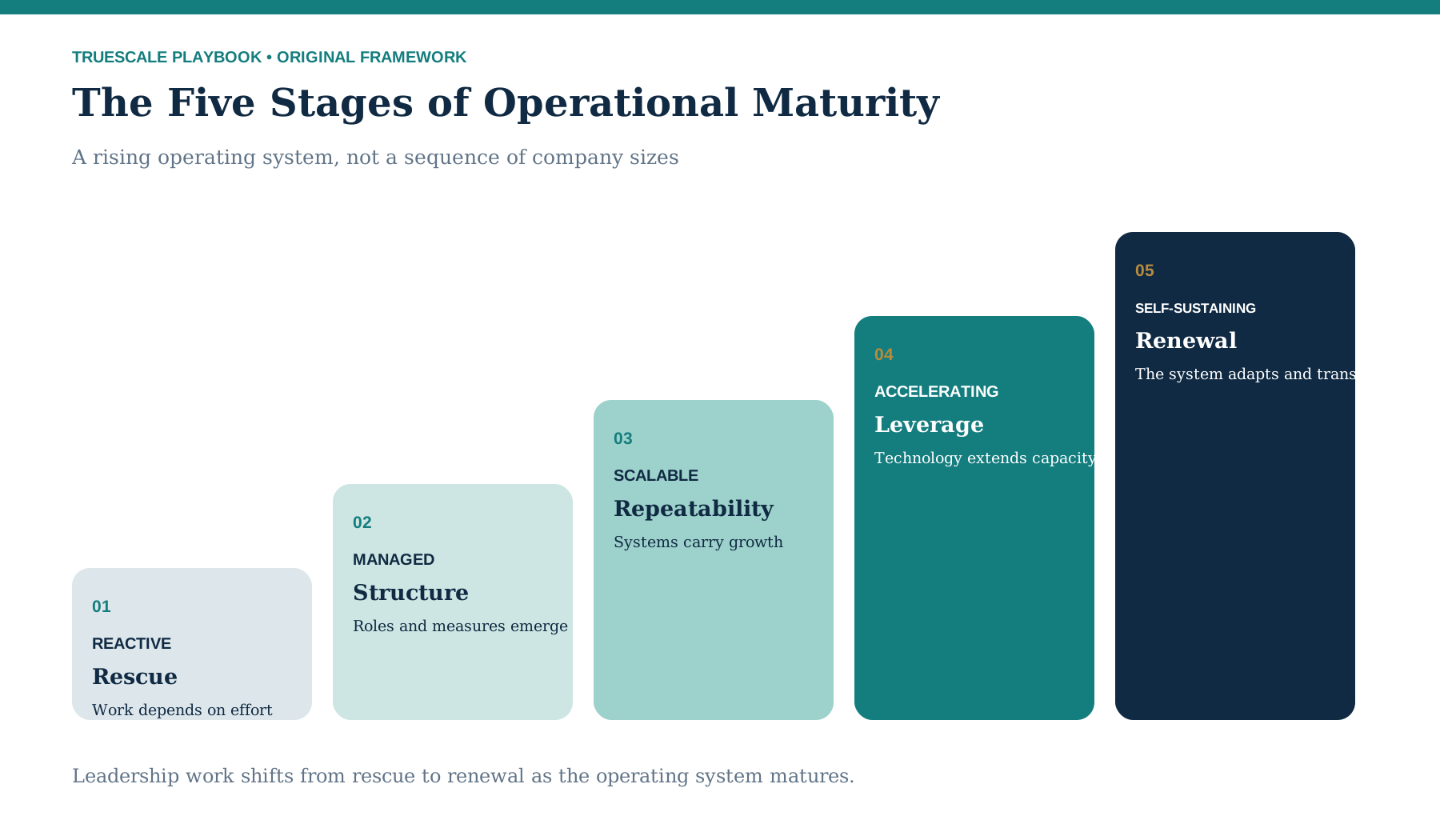
Reactive → Managed → Scalable → Accelerating → Self-Sustaining
Each stage adds a different kind of discipline. Reactive organizations need control. Managed organizations need consistency. Scalable organizations need integration. Accelerating organizations need intelligent leverage. Self-Sustaining organizations need renewal.
The stages build on one another, but they aren't a corporate ladder. Different functions can sit at different stages. Customer operations may be Scalable while finance remains Managed. A newly acquired business unit may be Reactive inside an otherwise mature company. A rapid product launch can temporarily pull a team backward. The goal isn't to defend a label. It's to find the operating constraint that matters now.
Read the system, not the aspiration
This is the principle I come back to: read the system, not the aspiration. Leaders naturally describe the organization they intend to build. A maturity diagnosis has to describe the system people actually use today.
I start with ordinary work. When a decision falls outside the standard path, who resolves it? When performance misses a target, does the team know what action follows? When a key employee is unavailable, does work continue? When a manager moves into a new role, can someone else inherit the team without rebuilding its operating logic from memory?
Those questions reveal more than an org chart or a dashboard. They show whether accountability, information, and judgment can travel through the organization without being carried by one person.
Use evidence from several parts of the business before assigning a stage:
- decision flow and escalation patterns;
- process ownership and exception handling;
- manager capability and coaching cadence;
- performance measures and review routines;
- onboarding, knowledge transfer, and cross-training;
- customer outcomes and operational variation; and
- technology, automation, and control discipline.
Don't let one polished process or one struggling team determine the label. You're looking for the dominant pattern, the operating tension it creates, and the decision leaders have to make next.
Stage One — Reactive
In a Reactive organization, the company moves through effort, proximity, and heroics. The founder or a small leadership group holds most of the context. People know whom to ask, even if they don't know the rule. Work gets done, but the route changes depending on who is available and how urgent the issue feels.
You'll recognize this stage when people can solve the problem but can't explain the system that produced the answer. Speed comes from access to the right person, not from a dependable way of working.
The operating tension is real. This flexibility may be exactly what an early team needs while it discovers the product and customer. But every new hire, handoff, and exception asks the same few people to carry more context. Leaders often mistake that responsiveness for capacity. It isn't the same thing.
What you can observe
- Priorities shift through direct messages, urgent meetings, and executive intervention.
- Processes live in memory, inboxes, or personal documents.
- The same issue receives different answers from different people.
- Managers spend most of their time assigning work and resolving exceptions.
- Metrics describe what happened after the fact, if they exist at all.
- Customer outcomes depend heavily on individual judgment and persistence.
The operating risk
The immediate risk is unpredictability. The deeper risk is that success hides fragility. A strong person can compensate for a weak system long enough for leaders to believe the system works. Growth then adds more volume, more handoffs, and more exceptions than those people can absorb.
Reactive doesn't mean incompetent. It describes how the work moves. The problem begins when leaders keep treating a pattern built for discovery as the permanent operating model.
The leadership behavior that helps
The first decision isn't how to document everything. It's where inconsistency is costing the business the most. Start with the work that creates the greatest customer risk, rework, delay, or executive escalation. Define the outcome, the owner, the few steps that can't be skipped, and the threshold for escalation.
The goal isn't comprehensive documentation. It's a stable floor.
The transition to Managed
The organization is ready to move when leaders can identify a small set of recurring workflows, assign clear ownership, establish basic measures, and review performance on a dependable cadence. The decision is to move critical work from personal memory into shared visibility without stripping away useful judgment.
Stage Two — Managed
A Managed organization has begun to install structure. Roles are clearer. Basic KPIs exist. Some processes are documented. Managers have recurring meetings and defined responsibilities. The company can see more of its operation than it could before.
This stage frustrates leaders because it feels like progress and limitation at the same time. The organization has enough structure to expose its gaps but not enough integration to resolve them consistently. You can see the problem now. You just can't fix it from where you're standing.
You'll recognize this stage when managers own results but not the dependencies that shape them, when escalation paths exist on paper but leaders still become the default tie-breakers, and when hiring has outpaced manager development.
What you can observe
- Core teams have goals, scorecards, and recurring operating reviews.
- Managers own results but may not control the dependencies that shape them.
- Processes are documented unevenly and interpreted differently across functions.
- Escalation paths exist, but leaders still become the default tie-breakers.
- Hiring has accelerated faster than manager development.
- Teams can report performance but struggle to explain variation or prevent recurrence.
The operating risk
The risk at this stage is local optimization. Each function improves its own work while cross-functional flow remains unclear. One team hits its target by moving cost, delay, or complexity downstream. Dashboards multiply. Meetings multiply. Accountability becomes louder without becoming more precise.
This is also where accidental managers become visible. The company promoted capable people, but the management system around them is still thin. They carry targets, coaching, staffing, quality, and escalation work without clear tradeoffs or decision rights. Leaders often read that strain as a manager problem when the role itself was never designed to succeed.
The leadership behavior that helps
Shift the conversation from individual effort to operating design. The first question isn't whether the manager is working hard enough. It's whether the organization has given that manager a system capable of producing the expected result. Ask where ownership crosses functions, where measures conflict, and which decisions still rise too high. Give managers a predictable coaching rhythm and authority boundaries they can use without seeking permission on every exception.
At this stage, leaders need to model consistency. If executives bypass the process whenever urgency rises, the organization learns that the process is optional.
The transition to Scalable
The move to Scalable begins when processes, measures, and decision rights connect across teams. The decision is to stop managing departments as separate boxes and start managing the flow of work from demand to outcome.
Stage Three — Scalable
A Scalable organization can absorb meaningful growth without rebuilding the operation each time volume increases. Leadership systems are established. Core processes have owners. Standards and exception paths are clear. Performance is predictable enough for leaders to make informed capacity and investment decisions.
You'll recognize this stage when the business can add volume without sending every exception back to the people who designed the original process. Managers can explain how work moves, where judgment belongs, and what the team will do when demand changes.
The tension shifts here. Leaders have worked hard to create consistency, and now they have to keep that consistency from becoming rigidity. Scalable doesn't mean every process is standardized. It means the organization knows where consistency matters and where judgment belongs.
What you can observe
- Core workflows have named owners, measures, controls, and review cadences.
- Decision rights are understood at the level where work happens.
- Managers spend more time coaching performance and improving systems than rescuing tasks.
- Onboarding teaches both the process and the judgment behind it.
- Teams use shared definitions for the measures that cross functions.
- Capacity planning connects demand, staffing, service levels, and financial choices.
The operating risk
The risk is believing the system is finished. That's the common misunderstanding at this stage. A process that created stability at one level of volume can become friction at the next. Standards can harden into habits. Dashboards can remain in place after the decisions they were built to support have changed.
The danger isn't too much structure by itself. It's structure without learning.
The leadership behavior that helps
Leaders have to protect the operating discipline while inviting challenge. Ask whether the process still improves the outcome, whether the measure still informs a decision, and whether the exception rate is revealing a changed reality.
This is the stage where continuous improvement must become part of management work rather than a side project. Managers should know not only how to run the process, but how to improve it without destabilizing the business.
The transition to Accelerating
The decision is whether the core operation is stable enough to add leverage without magnifying its defects. The organization is ready to accelerate when its core work is stable enough to automate, its data is reliable enough to guide decisions, and its leaders can distinguish useful leverage from expensive novelty.
Stage Four — Accelerating
An Accelerating organization uses technology, automation, data, and cross-functional learning to increase speed and capacity. The company isn't simply doing more of the same work. It's redesigning how the work happens.
You'll recognize this stage when leaders can name the operating problem before they name the technology. Teams know the baseline, the expected result, the owner, and the conditions that require human review.
The tension is between speed and control. Automation matters here, but the stage isn't defined by tools. It's defined by the organization's ability to introduce leverage without losing accountability, quality, or human judgment. Leaders often misunderstand this stage as a technology upgrade. It's an operating-model test.
What you can observe
- Teams use leading and lagging measures together to guide action.
- Automation removes repetitive work from stable processes.
- Data from customers, operations, workforce, and finance can be connected.
- Leaders test changes against explicit outcomes and guardrails.
- Cross-functional teams improve end-to-end work instead of optimizing isolated steps.
- Managers can shift capacity toward higher-value decisions, coaching, and improvement.
The operating risk
The risk is scaling a bad assumption. Automation can make a broken process faster. A model can make an inconsistent decision more consistent without making it correct. A new dashboard can create confidence without improving the underlying data.
The faster the system moves, the more important it becomes to define ownership, monitoring, and a clear path for human intervention.
The leadership behavior that helps
Before you automate a process, make sure you understand why it works the way it does. Require a business problem before approving a tool. Define the decision or workflow to improve, the baseline, the expected benefit, the risks, and the person accountable for the result. Run bounded tests. Keep a human review path where the cost of error is meaningful.
Acceleration works when technology sits inside a disciplined operating model. It fails when technology is asked to replace one.
The transition to Self-Sustaining
The move to Self-Sustaining happens when continuous improvement, leadership development, succession, and renewal no longer depend on a single executive sponsor. The decision is to make learning part of the operating system instead of treating it as a program that survives only while one leader is pushing it.
Stage Five — Self-Sustaining
A Self-Sustaining organization can maintain performance, develop leaders, transfer knowledge, and adapt its systems without depending on a few people to hold everything together. This doesn't mean the company runs itself. It means leadership attention goes toward direction, renewal, and consequential choices rather than routine rescue.
You'll recognize this stage when a leadership transition, market shift, or process change doesn't force the organization to rebuild its operating rhythm from scratch. People can adapt the system because they understand both the standard and the reasoning behind it.
The tension is easy to miss. Mature systems create confidence, but confidence can turn into complacency. Leaders sometimes mistake stability for permanence and protect the practices that worked yesterday instead of testing whether they still fit the business.
What you can observe
- Critical roles have credible succession and knowledge-transfer plans.
- Leadership expectations are consistent across levels and functions.
- Teams detect performance shifts early and act within defined boundaries.
- Process owners revise standards as customers, strategy, and technology change.
- Improvement priorities connect to business objectives rather than isolated efficiency targets.
- The organization can absorb leadership transitions without losing its operating rhythm.
The operating risk
The risk is entropy. Strong systems degrade when people stop examining them. Mature organizations can become protective of the practices that made them successful, even when those practices no longer fit the market or the workforce.
Self-Sustaining should never mean self-satisfied.
The leadership behavior that helps
Leaders at this stage protect renewal. They keep succession active, challenge stale assumptions, review whether the operating model supports the strategy, and make room for controlled experimentation. They also watch for hidden key-person dependencies that can reappear after growth, acquisition, or executive turnover.
The decision is what the organization must keep, what it must relearn, and what it must be willing to replace. The work is less about installing basic control and more about preserving adaptability.
The transition test
Don't move to the next stage by adopting its vocabulary. I would rather see a team solve one real constraint than announce a maturity level it can't sustain. Move when the current stage can operate without constant executive compensation.
Executive working tool
Before you declare a transition, ask:
- Can the current system produce a dependable result across teams, not just in one strong function?
- Can managers explain who decides, who owns the outcome, and what triggers escalation?
- Can leaders see performance early enough to act?
- Can the organization maintain the process when a key person is unavailable?
- Can the team improve the system without waiting for a crisis?
If the answer is no, the next-stage tool may create more activity without resolving the current-stage constraint.
Executive working tool
Where is your organization operating today?
- Which stage describes the dominant operating pattern—not the aspiration?
- Which function is one stage ahead, and what can the rest of the company learn from it?
- Which function is one stage behind, and what risk does that create?
- What evidence would show that the current constraint has actually changed?
- What is the smallest next-stage capability the business needs now?
Choose one stage transition to manage. Name the constraint, assign an executive owner, and decide what evidence will show that the organization is ready to move.
Understanding where you are is the first step. Knowing how to move forward is the second. That's what the TrueScale Method™ is designed to do.
The TrueScale Method™
Assess → Stabilize → Scale → Accelerate
Advice without sequence creates activity. A leadership team can leave an off-site with twenty good ideas and still be unclear about what to do Monday morning. The problem isn't a shortage of recommendations. It's the absence of an operating order.
I've watched leadership teams leave off-sites energized and return to the same operating problems within a month. The recommendations weren't wrong. The order was. They tried to stabilize something they hadn't examined, scale something they hadn't stabilized, or automate something that was still producing inconsistent results.
The TrueScale Method™ exists to fix the order:
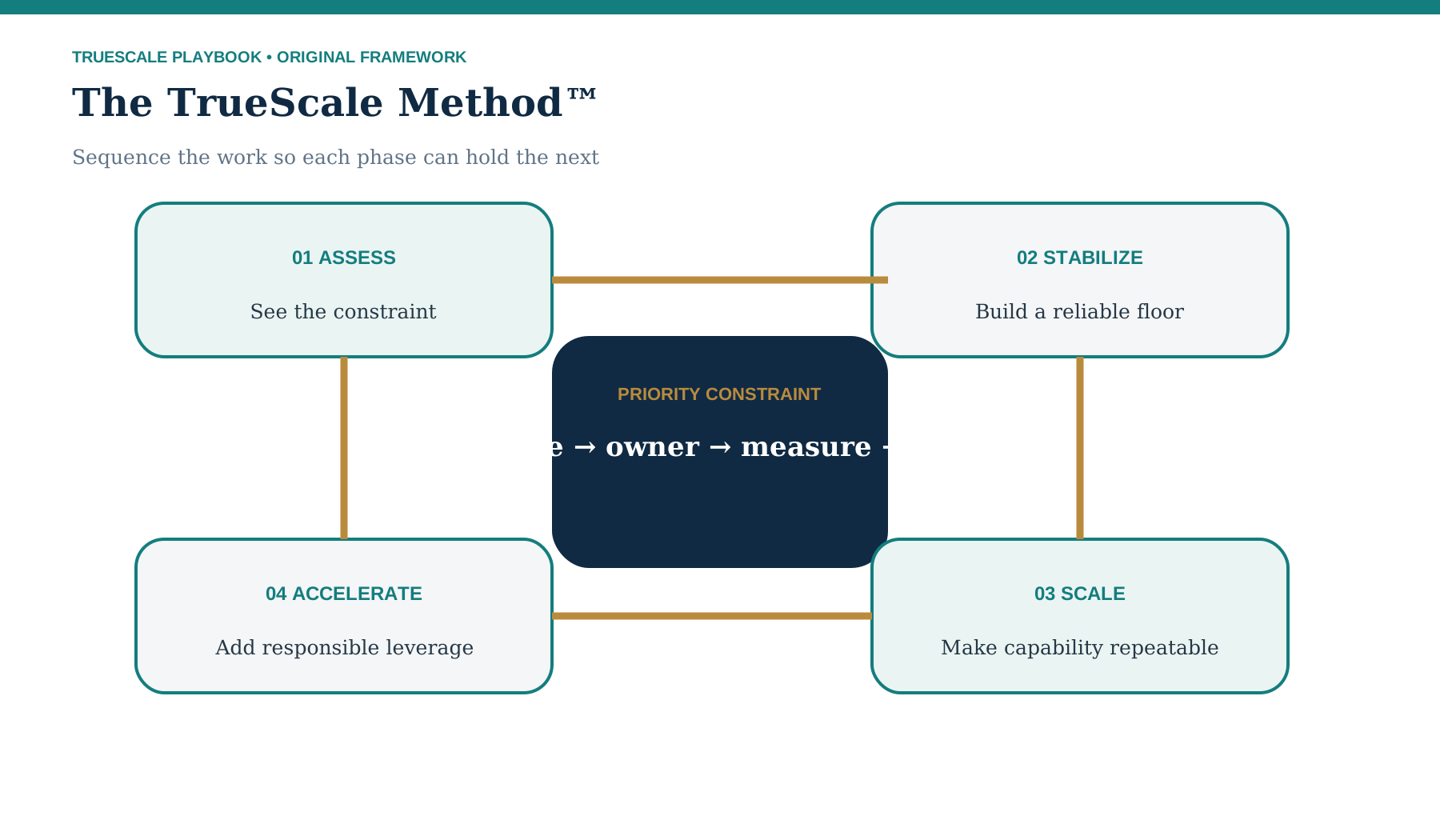
Assess → Stabilize → Scale → Accelerate
Each phase answers a different executive question.
- Assess: What is preventing this organization from scaling?
- Stabilize: What needs to be fixed before we add more volume or complexity?
- Scale: What leadership and operating infrastructure will let growth continue without constant intervention?
- Accelerate: Where can technology, automation, and continuous improvement create responsible leverage?
The sequence matters. If you automate before you understand the work, you can scale confusion. If you hire before you stabilize ownership, you add capacity to an unclear system. If you standardize before you identify the real constraint, you can make the wrong work more consistent.
The Method isn't a rigid checklist. Industry, regulation, team size, customer promise, and growth stage all affect implementation. The phases stay consistent. The decisions inside them have to fit the business. My job in each phase is to help leaders make the next decision with enough clarity that the organization can act on it.
Phase One — Assess
Executive question: What is preventing this organization from scaling?
Assessment begins with evidence, not assumptions. Leaders usually know where they feel pain. They may not know which operating mechanism creates it.
A customer escalation can look like a service problem when the deeper issue is unclear authority. Manager burnout can look like a capacity problem when the team is repeatedly correcting undocumented work. Slow decisions can look like bureaucracy when three functions are using different definitions of the same KPI.
When I assess an operation, I don't begin with the full catalog of what could be improved. I start where effort is covering for missing structure. Where does work wait? Where does it come back? Which executive has become a queue? The point of Assess is to separate symptoms from constraints so leaders can choose what deserves attention first.
Start with the work
Leadership. Start with decision flow, not the org chart. Look at spans of responsibility, escalation load, management capability, succession exposure, and the places where executive judgment has become a queue. A role can look clear on paper while every consequential choice still moves upward.
Operations. Trace a few critical workflows from beginning to end. Identify ownership, handoffs, standards, exceptions, rework, and dependencies. I care less about the elegance of the process map than the questions it forces: Where does work wait? Where does it come back? Where does someone have to translate what the process means?
Customer experience. Connect customer outcomes to operating conditions. Review feedback, retention signals, resolution patterns, service variation, and the moments when teams override the process to protect the customer. Those overrides often show you where the operating model no longer fits the promise.
Workforce. Examine staffing assumptions, hiring, onboarding, scheduling, workload, and manager capacity. Don't confuse approved headcount with productive capacity. A seat on the plan doesn't help the operation until someone can perform the work reliably.
Technology and data. Identify the systems that hold critical information, the manual work that connects them, the quality of key data, and the reporting or automation gaps that affect decisions. Start with the decision the data has to support. Otherwise, a systems inventory becomes another list with no operating consequence.
Decide what matters first
Assessment is complete when leaders can make three decisions. Until then, the team is still describing the problem.
- What is the priority constraint? Not every weakness deserves the same attention.
- What must be protected while the system changes? Stability matters during improvement.
- What evidence will show progress? A recommendation without a measure is only an intention.
What Assess must produce
The output is a current-state view that names the most important constraints, the risks they create, and the sequence in which to address them. In the TrueScale architecture, this is the role of the TrueScale Assessment™: current-state analysis, risk assessment, key-person dependency, top growth constraints, and executive recommendations.
The document isn't the value by itself. The value is the decision clarity it creates. If the assessment names ten equal priorities, it hasn't done its job.
Phase Two — Stabilize
Executive question: What needs to be fixed before scaling?
Stabilization reduces the organization's dependence on urgency and heroics. It creates a reliable operating floor: clear ownership, visible performance, dependable review routines, and explicit escalation paths.
This is where leaders are tempted to launch a full transformation program. Resist that impulse. If you try to repair every process at once, the improvement effort becomes another source of operational load. Stabilize the constraint that creates the most risk or consumes the most leadership attention. The tradeoff is focus: some worthwhile improvements will have to wait so the critical system can hold.
Build the smallest reliable operating floor
Accountability. Every critical outcome needs an owner with enough authority to act. Name the result, not just the task. Then separate the person who decides from the people who advise, execute, or need to know. If the owner still has to ask permission on every exception, you haven't moved the decision.
Visibility. Build a small scorecard around decisions. Each KPI needs a definition, source, owner, review cadence, threshold, and response. I would rather see five measures that change decisions than fifty measures the team only explains.
Leadership rhythm. Establish the few recurring forums the operation needs: a short team cadence for immediate blockers, an operating review for performance and decisions, and a business review for trends, tradeoffs, and priorities. Each forum needs a distinct purpose. If the same issue appears in all three, the meeting structure is moving the conversation, not resolving it.
Escalation design. Define what teams can resolve, what conditions require escalation, who receives the issue, and what information must travel with it. Escalation should be a controlled path, not a sign that a manager has failed. The goal is to protect judgment for the exceptions that truly require it.
Process minimums. For the most critical work, specify the required outcome, the steps that protect quality or compliance, the discretion people retain, and the exception path. Don't document every movement. Document what the team can't afford to rediscover.
Decide what must change now
Stabilization requires leaders to make choices they may have postponed:
- which decisions move down and which remain at the executive level;
- which measures matter now and which reports can stop;
- which operating forum owns each type of issue;
- which process variation is acceptable and which creates material risk; and
- what temporary workaround must be removed instead of institutionalized.
What Stabilize must produce
The output is a working operating system: a KPI framework, operating cadence, accountability map, meeting structure, and defined escalation paths. The test is practical. Does work move with less rescue, less waiting, and fewer avoidable escalations? The system should make the operation easier to run before it makes the slide deck more impressive.
Phase Three — Scale
Executive question: How do we grow without breaking?
Once the core operation is stable, Scale builds the capability to absorb more customers, employees, locations, products, and partners without recreating the same dependencies at a larger size.
Leaders often treat Scale as a headcount or technology question. I treat it as a capability question. Can the organization repeat the work, teach the judgment behind it, and preserve the customer promise as volume changes? Scaling is capacity the business can actually use.
Build capacity the business can use
Leadership development. Define what managers are accountable for beyond personal output. Give them a coaching cadence, performance measures, authority boundaries, and a clear path for development. Training helps, but the role itself has to be designed. Don't ask managers to create clarity the organization hasn't given them.
Workforce scaling. Connect demand forecasts to staffing, hiring lead time, onboarding capacity, scheduling, proficiency, and attrition risk. Headcount isn't capacity until people can perform the work to standard. Hiring faster than the team can train may increase the backlog before it reduces it.
Operational consistency. Build practical playbooks, quality controls, knowledge ownership, and change routines. Standardize the work where inconsistency creates risk. Preserve judgment where context genuinely matters.
Cross-functional flow. Manage the handoffs that determine customer and business outcomes. A scalable company can't rely on each department optimizing its own queue. The customer experiences the whole flow, not the individual scorecards.
Partner and vendor governance. Define service expectations, measures, issue paths, review cadences, and ownership for outsourced or partner-supported work. External capacity still requires internal management discipline.
Succession and resilience. Identify critical roles and knowledge concentrations before they become emergencies. Cross-train, document decision logic, and create credible coverage for leadership and operational continuity.
Decide where consistency matters
Scale requires choices about where to standardize, where to invest, and where to tolerate variation. Too much variation creates risk. Too much standardization can slow the judgment the business still needs. Leaders have to decide:
- which capabilities must be built internally;
- which work can be delegated, automated, or supported by a partner;
- what level of manager span and workload is sustainable;
- which customer promises the operating model can reliably support; and
- what must be true before the next wave of hiring or expansion begins.
What Scale must produce
The output is growth infrastructure: hiring and onboarding frameworks, manager development, workforce planning, operational playbooks, quality routines, and governance for critical partners.
The test is straightforward. Can the business add volume without adding the same amount of executive intervention? If every growth wave recreates the same approvals, rescues, and knowledge bottlenecks, the company has added size without adding scale.
Phase Four — Accelerate
Executive question: How do we become more efficient and future-ready without weakening control?
Acceleration begins after the organization can explain how the work should operate. That makes it possible to redesign, automate, and improve the system deliberately.
The goal isn't to collect tools. It's to create leverage. If you automate before you understand the work, you can scale confusion.
Create leverage without losing control
Workflow automation. Remove repetitive movement, data entry, routing, and reporting from stable processes. Keep ownership and exception handling visible. Before you automate, ask whether the current variation is intentional judgment or an unresolved defect.
AI enablement. Use AI where the task, data, risk, and review path are understood. Possible applications include knowledge retrieval, quality review, classification, forecasting support, and the automation of low-risk administrative work. The operating model still needs a responsible owner and a human path for consequential decisions. A model can support judgment. It can't own the outcome.
Performance intelligence. Connect measures across customer, workforce, operations, and finance so leaders can see the operating relationship earlier. Use leading conditions to trigger action and lagging results to evaluate whether the action worked. Don't claim cause and effect when the evidence only shows a pattern worth testing.
Continuous improvement. Create a method for identifying opportunities, testing changes, measuring impact, and incorporating what the organization learns. Improvement should not depend on a crisis or an annual initiative.
Cost and capacity management. Make the economics of operating choices visible. Efficiency work should protect the customer promise and the organization's ability to adapt.
Decide what is ready for leverage
Acceleration requires leaders to slow down long enough to make a few consequential decisions:
- which problem is worth automating;
- whether the process and data are stable enough to automate;
- what baseline and expected outcome will define success;
- where human review is required;
- how the organization will monitor drift, error, and unintended effects; and
- who owns the system after implementation.
What Accelerate must produce
The output is an optimization blueprint: prioritized automation opportunities, an AI roadmap with controls, refined measures, cost and capacity choices, and a continuous-improvement portfolio.
Acceleration is successful when the organization becomes faster and more capable without becoming harder to understand or govern. If speed makes ownership less clear or errors harder to detect, the organization has added velocity without adding control.
The Method is sequential, not strictly linear
The four phases create an order, but real organizations don't move through them once and finish. A new acquisition may need an assessment while the core business is accelerating. A new product can expose a stabilization need inside a scalable operation. A technology change may require leaders to reassess data quality, ownership, and risk.
The feedback loop is intentional:
Assess the current condition. Stabilize the constraint. Scale the capability. Accelerate what is ready. Then assess again.
What matters is that the organization doesn't skip the decision logic. When results drift, I go back to the earliest phase that no longer holds. Every acceleration effort should be able to trace back to a constraint, an owner, a measure, and an operating outcome.
Six implementation principles
These principles keep the Method from turning into a long list of initiatives. They force a leadership team to choose, sequence, and test the work instead of confusing motion with progress.
1. Start with the constraint, not the catalog
Don't begin with every practice the organization could improve. Begin with the operating condition that most limits performance or creates the most risk. If you can't name that constraint, you aren't ready to choose the intervention.
2. Protect the customer and the core operation
Improvement work has to coexist with current demand. Define what cannot degrade while the system changes, who will watch it, and what will trigger a correction.
3. Install the minimum system that changes behavior
Use the lightest useful mechanism: one decision rule, one owner, one scorecard, one review cadence. Add complexity only when the work requires it. The point is to change behavior, not to prove that a program exists.
4. Make ownership executable
An owner needs authority, information, a review rhythm, and a clear outcome. Naming a person without changing the system only relocates frustration.
5. Measure the change, not just the activity
Track whether decisions move faster, rework declines, performance becomes more predictable, or managers regain time for leadership. Completion is not the same as impact.
6. Build the next phase only when the current one can hold
The test for progress isn't whether the tool launched. It's whether the operating behavior persists without extraordinary intervention. If the new process works only while the project team is watching, it hasn't become part of the operation.
Executive working tool
Build your four-phase constraint map
Use one page and answer four questions:
- Assess: What operating constraint is most limiting growth or creating risk right now?
- Stabilize: What ownership, visibility, or operating rhythm would reduce that constraint?
- Scale: What capability must become repeatable before the next wave of growth?
- Accelerate: What stable work could technology or continuous improvement make faster, easier, or more predictive?
Choose one action, one owner, and one measure. Put the review date on the leadership calendar. Chapter 4 shows whether the work is already urgent.
The Ten Warning Signs You're Outgrowing Your Systems
Operational strain rarely announces itself as a strategy problem. It shows up in the work. By the time it reaches the strategy conversation, it has usually been showing up in the work for months.
You usually don't discover an operating system problem through one dramatic failure. You discover it through patterns: the same approval waits, the same manager rescues, the same customer issue returns, and the same numbers require a long explanation every month.
Each event can look manageable by itself. Together, they tell you the company has outgrown part of the system that once helped it succeed.
The ten warning signs in this chapter are a practical screen, not a validated diagnostic instrument. Use them to focus executive attention and decide what to examine next. A sign matters most when it repeats, crosses functions, affects customers or people, or requires senior leaders to compensate for it.
When I read these signs, I don't begin with the count. I look for the dependency they share. Three different symptoms may come from the same missing decision rule, the same unclear handoff, or the same overloaded manager. That's the pattern leaders need to act on.
1. Every decision comes back to one executive
The recognizable situation
The team completes the analysis, but the work waits for one person to choose. Managers have authority in the org chart and uncertainty in practice. A refund, exception, hire, process change, or customer concession moves upward because nobody can explain the boundary between acceptable judgment and unacceptable risk.
The executive may respond quickly. That can hide the design problem. Fast approval is still a queue when every decision needs it. The question isn't whether the executive can decide. It's whether the decision belongs there.
What it usually means
Decision rights are unclear, confidence is low, or the organization has taught people that waiting is safer than deciding. The bottleneck may also be reinforced by an executive who asks to stay involved but hasn't made the cost of that involvement visible.
What to examine
- Which decisions reached the executive in the last two weeks?
- How many followed the same pattern?
- What could have been decided one or two levels lower?
- What threshold, policy, or review cadence would make that safe?
- Does the manager have the information and authority needed to act?
The appropriate response
Group the decisions by type. Define the boundary for each type: what the team decides, what requires consultation, and what must escalate. Review outcomes after the decision rather than requiring permission before every decision. That's how you build judgment without abandoning control.
The goal is not to remove leaders from consequential choices. It is to protect their judgment for the choices that deserve it.
2. Managers spend more time firefighting than coaching
The recognizable situation
Managers spend the day answering urgent questions, correcting completed work, handling escalations, and covering staffing gaps. One-on-ones move. Coaching becomes informal. Process improvement waits for a quieter week that never arrives.
What it usually means
The manager role is absorbing defects from the system. The first question isn't whether the manager needs better time management. It's whether the system keeps sending the manager work that should have been resolved elsewhere. The team may lack clear standards, useful measures, capacity visibility, decision boundaries, or dependable escalation paths. The manager becomes the operating control because the operation doesn't have one.
What to examine
- How does a manager's week divide among rescue, administration, coaching, and improvement?
- Which problems repeat?
- What work returns for correction, and why?
- Which decisions can the team make without the manager?
- What coaching or performance cadence is being displaced?
The appropriate response
Don't begin by asking managers to manage time better. Remove one recurring source of rescue work. Clarify the standard, owner, measure, and response. Then protect a consistent coaching cadence and measure whether the manager's work actually changes.
3. Customer experience declines as volume grows
The recognizable situation
Demand rises, but service becomes less consistent. Resolution takes longer. More customers need follow-up. Exceptions increase. Teams compensate with manual work, special handling, and manager overrides.
What it usually means
The operating model was designed for lower volume or tighter proximity. Handoffs, capacity assumptions, knowledge access, and quality controls haven't grown with demand. The customer sees the accumulated friction before the dashboard explains it.
What to examine
- Where does the customer journey cross teams or systems?
- Which step becomes a queue as volume rises?
- Are teams solving the same issue more than once?
- Which customer outcomes vary most by person, shift, or location?
- Are managers overriding the process to preserve the experience?
The appropriate response
Trace one high-volume customer journey end to end. Define the outcome, the owner of the full flow, the few leading conditions that warn of failure, and the handoffs that need redesign. Don't optimize each department separately and expect the customer experience to repair itself. The customer experiences the handoffs even when the org chart hides them.
4. New hires take months to become productive
The recognizable situation
The onboarding plan exists, but new employees still depend on the person sitting nearby. Training explains the official process. Experienced employees explain how the work actually happens. Managers can't say when a new hire should reach proficiency or what evidence demonstrates readiness.
What it usually means
Critical knowledge remains tribal. I don't treat slow onboarding as a training issue alone. It often tells you that the work itself isn't clear. The role may also be too broad, the workflow may be unclear, or the quality standard may depend on judgment that nobody has made explicit.
What to examine
- What must a new hire know, do, and decide at 30, 60, and 90 days?
- Which knowledge lives only with experienced employees?
- Where do new hires wait for access, feedback, or approvals?
- Can managers define proficiency in observable terms?
- Which early errors reveal a process problem rather than an individual problem?
The appropriate response
Build onboarding around the work, not the orientation calendar. Define the critical workflows, proficiency checkpoints, practice opportunities, feedback cadence, and exception logic. Assign ownership for the content so onboarding changes when the operation changes.
5. KPIs are reactive instead of predictive
The recognizable situation
The leadership team receives accurate reports after the outcome can no longer be changed. Revenue, churn, complaints, backlog, or attrition tell leaders what happened. The review explains the past but doesn't reveal where to intervene now.
What it usually means
The organization has lagging measures without leading conditions. It may also have too many measures, inconsistent definitions, or reports with no named decision attached. Whenever a metric appears in a leadership review, ask: What decision does this number improve? If nobody can answer, the report is describing performance without helping anyone manage it.
What to examine
- What decision should each KPI improve?
- Which conditions change before the result changes?
- Who owns the response when a threshold is crossed?
- Are teams using the same definition and source?
- Does the review end with an action, or only an explanation?
The appropriate response
Keep the lagging result, then add the few leading conditions the team can influence. Define the threshold and response before the next review. A useful measure should make the decision easier, earlier, or more precise.
6. The same problems surface in every quarterly review
The recognizable situation
The issue is familiar. Leaders discuss it, assign follow-up, and move on. The next quarter, the symptom returns in a different customer segment, team, or metric. Everyone remembers the conversation. Nobody can point to a changed operating mechanism.
What it usually means
The organization is treating recurrence as a series of events instead of a system problem. Actions may address the immediate case while ownership, process, measure, or decision logic remains unchanged.
What to examine
- What action was assigned the last time?
- Did it correct the case or change the system?
- Who owns prevention across functions?
- What evidence would show that the root condition changed?
- Is the issue discussed in a forum that has authority to resolve it?
The appropriate response
Choose one recurring issue and trace the pattern across time. Name the root operating condition, assign one accountable owner, and define a measure that can show recurrence declining. Don't close the item because someone completed a task. Close it when the operating mechanism has changed and the evidence holds.
7. Your best people are burning out
The recognizable situation
The dependable people receive the hardest work, the most questions, and the most exceptions. Their calendars fill because the organization trusts them. They become reviewers, trainers, escalation points, and informal process owners without losing their original responsibilities.
What it usually means
The business is using high performers as invisible infrastructure. I pay close attention when the same names appear in escalation paths, training plans, quality reviews, and exception handling. Capacity planning may ignore the support work they carry. Knowledge and authority may also be concentrated in too few people.
What to examine
- Who receives work when something is unclear?
- Which employees are essential to several processes?
- How much unplanned support work do they carry?
- What stops when they are unavailable?
- Which responsibilities need a formal owner, backup, or standard?
The appropriate response
Make the dependency visible. Remove recurring support demand where possible, distribute knowledge, define backups, and adjust workload. Recognition is not a substitute for operating redesign.
8. Decisions take longer than they used to
The recognizable situation
More people attend the meeting. More functions need to be consulted. Analysis expands. The team revisits decisions because the owner, criteria, or tradeoff was unclear. Leaders describe the delay as collaboration, but the work experiences it as waiting.
What it usually means
Growth has added dependencies without adding decision architecture. The organization may confuse participation with authority, or it may lack a common set of facts and decision criteria.
What to examine
- Who owns the decision?
- Who provides required input, and by when?
- What information is necessary versus merely available?
- What decision is being made, and what is out of scope?
- When does delay create more risk than an imperfect choice?
The appropriate response
Define the decision before convening the group. Name the decider, required inputs, criteria, deadline, and escalation path. Separate discussion from approval. Then review whether the decision produced the intended outcome. More participation won't fix a decision nobody owns.
9. You're hiring faster than you can train
The recognizable situation
Headcount grows while experienced employees spend more time onboarding, checking, and correcting work. Managers carry larger teams and less coaching capacity. Hiring solves a visible capacity problem but creates a proficiency problem behind it.
What it usually means
The hiring plan is disconnected from onboarding capacity, manager span, knowledge transfer, and the time required to reach proficiency. The organization counts seats before it can convert them into dependable capacity.
What to examine
- How many new hires can each manager and team absorb at once?
- What is the expected proficiency curve for the role?
- Who trains, observes, and certifies readiness?
- Which experienced employees lose productive time during each hiring wave?
- Is demand growing faster than onboarding capacity?
The appropriate response
Plan hiring and onboarding as one operating system. Sequence start dates, protect trainer capacity, define proficiency checkpoints, and adjust manager spans. Ask what the team can absorb, not only what the budget can approve. If the team cannot absorb the hires, adding more people may increase the backlog before it reduces it.
10. Everyone knows something is wrong, but no one can prove it
The recognizable situation
Leaders hear concerns about quality, workload, customer frustration, or slow execution. Each team has a piece of the story. The data lives in different systems, definitions conflict, and no operating review brings the evidence together.
What it usually means
The organization lacks shared visibility. It may measure outputs without measuring the conditions that create them. It may also lack a forum where cross-functional evidence can become a decision.
What to examine
- Which concerns repeat across teams?
- What evidence exists, even if it is incomplete?
- Which definitions or systems prevent comparison?
- What would you need to know to act responsibly?
- Who owns assembling and reviewing that evidence?
The appropriate response
Create a bounded fact-finding cycle. Define the question, collect a small set of relevant measures and examples, reconcile definitions, and review the evidence with the people who own the work. You don't need perfect data to begin, but you do need to separate what is known, what is inferred, and what still needs to be tested.
Read the pattern, not only the count
The warning-sign screen uses three qualitative categories:
- 0–2 signs — Monitor: Keep building and watch for concentration in one critical area.
- 3–5 signs — Attention Required: Choose the highest-risk pattern before the problems compound.
- 6–10 signs — Priority Review: Give the operating pattern prompt executive attention and determine what must be stabilized.
These categories are an internal prioritization aid, not a validated diagnostic instrument or a researched prediction of business failure. I use the count to start the conversation, then move quickly to the pattern and the severity of the risk. One issue that threatens customers, compliance, cash, or a critical operation can matter more than several lower-risk signs. The count never overrides executive judgment.
Three signs linked to decision rights may point to a founder bottleneck. Three signs linked to onboarding, manager rescue, and burnout may point to a capability and capacity problem. A single sign affecting a regulated process or a major customer can matter more than several low-risk irritants.
Executive working tool
Run a 30-minute warning-sign review
Ask each executive to mark the signs they can support with current evidence. For every marked sign, capture:
- the observable situation;
- the business, customer, or people risk;
- the evidence already available;
- the likely operating mechanism;
- the executive owner; and
- the next fact or action needed.
Then cluster the signs. Choose the priority constraint, not the loudest anecdote. Assign one owner and revisit the evidence at the next operating review.
These warning signs aren't just inconvenient. Left alone, they become operational debt: more rework, more delay, more dependency, and more leadership attention spent maintaining a system that no longer fits the business.
The next chapter examines that cost.
The Cost of Operational Debt
Operational debt doesn't appear as one line on the income statement. It shows up as extra meetings, duplicated work, and leaders solving yesterday's problems. You have to reconstruct it from the work.
Every organization carries some operational debt. A team takes a shortcut to meet a deadline. A manager keeps a manual tracker because the system doesn't show what the team needs. A founder holds one more approval because the decision rule isn't ready. Those choices can be reasonable in the moment.
The problem begins when a temporary workaround becomes the way the business operates. People build routines around it. New hires learn it. Managers absorb the extra work. The cost spreads across payroll, customer outcomes, capacity, and leadership attention, but no single report shows the total.
That's why operational debt is easy to tolerate. The business can still grow while the operating model gets more expensive to maintain. Revenue may hide the friction for a while. Effort may hide it even longer.
I use the term operational debt to describe the accumulated cost of running important work through unclear ownership, unstable processes, weak information, and repeated executive intervention. The debt isn't the existence of a problem. It's the recurring cost of compensating for a problem the organization hasn't resolved.
This chapter gives you a way to estimate that cost without pretending the estimate is more precise than the evidence allows.
Start with the cost you can observe
Leaders often ask for one number: What is operational debt costing us? I understand the question, but I wouldn't begin with a total. I would begin with the operating behaviors that create the cost.
Look for work that repeats because the first pass didn't hold. Look for hours managers spend rescuing work that should move without them. Look at the gap between a new hire's start date and the point when that person can perform independently. Look at the customers, employees, and opportunities the company loses for reasons connected to how the operation works.
Then decide which of those costs you can measure, which you can reasonably estimate, and which should remain a risk statement until the evidence improves.
The distinction matters. A rough estimate can help a leadership team choose a priority. A false sense of precision can send the team after the wrong one.
A practical cost framework
I group operational debt into six cost pools. They overlap, so you have to watch for double counting. Used carefully, they give executives a common way to connect operating friction to financial consequences.
1. Rework and correction
Rework includes tasks repeated because information was missing, the standard was unclear, a handoff failed, or an exception reached the wrong person. It may appear as corrected cases, reopened tickets, duplicate data entry, revised reports, repeat customer contacts, or quality-review failures.
The cleanest calculation starts with volume and time:
Annual rework capacity value = affected units per period x avoidable hours per unit x loaded hourly cost x periods per year
Use only the portion of the work you believe is avoidable. If a review step is required for safety, compliance, or quality, it isn't automatically waste. The question is whether the same outcome could be achieved with less repeated effort or fewer defects.
2. Management rescue
Management rescue is the time leaders spend making routine decisions, correcting preventable problems, locating information, or personally moving work across a broken handoff. Some intervention is part of leadership. The debt is the portion created by a system that repeatedly sends the same work upward.
Annual management rescue capacity value = managers involved x avoidable rescue hours per week x loaded hourly cost x working weeks
This estimate still understates the effect if rescue work displaces coaching, planning, hiring, or improvement. I keep the direct labor calculation separate from the opportunity cost so the leadership team can see what is measured and what is inferred.
3. Onboarding drag
Onboarding cost isn't limited to recruiting fees or orientation time. The operation also pays for the gap between starting the job and performing it reliably, plus the time experienced employees spend training, checking, and correcting work.
You can model the ramp component this way:
Ramp drag = hires x weeks to proficiency x weekly hours x average productivity gap x loaded hourly cost
Then add the support component:
Training support = hires x trainer hours per week x training weeks x trainer loaded hourly cost
These are planning assumptions, not universal benchmarks. Use the proficiency curve for the actual role. A customer support role, a finance role, and an executive role won't have the same ramp.
4. Preventable turnover
Turnover calculations are often weakened by a borrowed headline number. I don't recommend applying a generic multiple of salary and calling it fact. Build the estimate from the costs the organization can defend, then remove any amount already captured elsewhere in the ledger:
- recruiting and assessment expense;
- vacancy coverage, overtime, or contractor support;
- manager and team time spent interviewing and onboarding, unless that time already appears under onboarding drag or management rescue;
- the productivity gap during ramp, unless it already appears under onboarding drag;
- customer or operational disruption tied to the vacancy; and
- knowledge that has to be rebuilt or transferred.
Preventable turnover expense = preventable departures x nonoverlapping modeled expense per departure
The hard part is the word preventable. Don't attribute every resignation to the operating system. Use exit evidence, manager patterns, workload data, and role-specific context. When causation is uncertain, present a range or a scenario instead of a single conclusion.
5. Customer revenue and margin at risk
Operational debt can reach the customer through slower response, inconsistent quality, failed handoffs, billing errors, missed commitments, or repeated escalation. The financial effect depends on the business model.
For a retrospective estimate, use customers whose loss or contraction has a documented operating cause:
Gross annual contribution at risk = affected customers x annual revenue per customer x contribution margin percentage
If the team has a supportable probability estimate, it can calculate a scenario-weighted exposure:
Scenario-weighted contribution exposure = gross annual contribution at risk x estimated probability of loss or contraction
Keep the gross and weighted figures side by side. The first shows the consequence if the scenario occurs. The second shows the assumption leaders are using for planning. Neither is cash savings.
For a prospective scenario, separate the number of accounts at risk from the probability of loss. Don't present the entire customer book as avoidable churn. And don't claim that an operating issue caused a departure unless the evidence supports that conclusion.
6. Lost capacity and delayed decisions
Not every lost hour turns into cash savings. That is one of the easiest mistakes to make in an efficiency case. If a process improvement gives a manager four hours back, the company hasn't automatically saved four hours of payroll. It has recovered capacity.
Recovered capacity becomes valuable when leaders decide what the time will replace: overtime, contractor expense, delayed customer work, an unfilled role, a backlog, or higher-value management activity.
Keep three categories separate and do not add them into a single savings claim:
- Avoidable expense: a cash outlay the organization can remove, such as contractor spend, overtime, or an external recruiting fee.
- Recoverable capacity value: paid time the organization can redirect. It becomes cash savings only if a documented expense or hiring plan changes.
- Risk exposure: a potential loss whose probability, timing, or causal link remains uncertain.
That separation makes the business case more credible.
The Operational Debt Ledger
Executive working tool
Build the ledger one operating issue at a time. For each issue, record:
- the observable behavior;
- the volume or frequency;
- the people or customers affected;
- the direct cost, capacity cost, or risk created;
- the evidence source;
- the assumptions used;
- the executive owner; and
- the action that would reduce the cost.
The ledger should make uncertainty visible. Mark each input as verified, estimated from internal evidence, or unknown. If an assumption changes the decision, test it before presenting the total as a commitment.
A reconciled illustrative calculation
The following example is hypothetical. It is designed to show the mechanics of the framework, not to provide a benchmark for any company.
Assume a hypothetical organization identifies five recurring effects. The figures below show the arithmetic and the financial category each figure belongs to.
| Effect | Reproducible calculation | Category | Annual estimate |
|---|---|---|---|
| Rework | 2,000 cases per month x 8/60 avoidable hours x $35 loaded hourly cost x 12 months | Recoverable capacity value | $112,000 |
| Management rescue | 12 managers x 4 avoidable hours per week x $75 loaded hourly cost x 52 weeks | Recoverable capacity value | $187,200 |
| New-hire ramp gap | 30 hires x 6 weeks x 40 hours x 25% gap x $32 loaded hourly cost | Recoverable capacity value | $57,600 |
| Trainer support | 30 hires x 3 trainer hours per week x 6 weeks x $45 loaded hourly cost | Recoverable capacity value | $24,300 |
| Preventable turnover | 8 departures x $18,000 of recruiting fees and vacancy coverage | Avoidable expense | $144,000 |
| Customer contribution at risk | 4 customers x $50,000 annual contribution | Risk exposure | $200,000 |
The example produces three decision numbers:
| Financial category | Included effects | Illustrative amount | What leaders may say |
|---|---|---|---|
| Avoidable expense | Preventable turnover | $144,000 | This expense may be reduced if the departures are preventable and the intervention works. |
| Recoverable capacity value | Rework, management rescue, ramp gap, and trainer support | $381,100 | This paid capacity may be redirected. It is not cash savings unless an expense or hiring decision changes. |
| Gross risk exposure | Customer contribution at risk | $200,000 | This is the consequence if the identified accounts are lost. It is not a forecast or guaranteed recovery. |
I would not add those figures and call the result $725,100 of savings. That number mixes expense, capacity, and exposure. The better executive view is $144,000 of modeled avoidable expense, $381,100 of recoverable capacity value, and $200,000 of gross customer contribution at risk.
The overlap rules matter. In this example, the $18,000 turnover assumption includes only recruiting fees and vacancy coverage. It excludes the new-hire ramp gap, trainer support, and manager time because those amounts already appear in other rows. The management-rescue estimate also excludes the trainer hours counted in onboarding. If internal evidence shows that some vacancy coverage sits inside management rescue, remove it from one category before presenting the case.
The estimates still need challenge. Leaders should test volume, time, attribution, loaded cost, and preventability. If the lower-bound avoidable expense or the recoverable-capacity case justifies action, there is no reason to inflate the conclusion.
Operational debt compounds through dependency
The cost pools don't remain separate. They feed one another.
An unclear process creates rework. Rework increases manager rescue. Rescue displaces coaching. Weak coaching slows new-hire development. Slow development pushes more work to experienced employees. Those employees burn out or leave. The team loses knowledge, and the process becomes even harder to run.
That is the compounding effect. The organization pays for the original weakness and for the dependencies created to compensate for it.
The right response isn't to attack every cost at once. Find the shared operating mechanism. One clear decision rule may reduce executive approvals, manager rescue, and cycle time. One owned onboarding path may reduce trainer interruption, quality variation, and early attrition. Fixing the mechanism is usually more valuable than trimming each symptom separately.
By the time leaders see the cost clearly, they are usually paying for the workarounds, not the original problem. That's why the largest number in the ledger is often the least useful one to act on. The shared mechanism is the leverage point.
Build the investment case
An operational improvement should compete for resources on the same terms as other investments. Define the problem, the cost you can defend, the intervention, the owner, the expected operating change, and the review date.
Use a range when evidence is incomplete:
- Lower bound: direct costs supported by current records.
- Planning case: direct costs plus reasonable, labeled assumptions.
- Upper exposure: material risks that could occur but shouldn't be treated as certain savings.
Then compare the intervention cost with the value the organization expects to recover. Include implementation time, technology, manager capacity, training, and disruption. A change can be directionally right and still be poorly sequenced.
Executive working tool
Estimate one source of operational debt
Choose one recurring issue from Chapter 4. Work through these questions:
- What behavior can we observe and count?
- How often does it happen?
- How much time, expense, capacity, or customer value does each occurrence affect?
- Which inputs are verified, estimated, or unknown?
- Where might the estimate overlap another cost?
- What operating mechanism creates the cost?
- What is the smallest intervention that could change that mechanism?
- What evidence will show that the cost is declining?
Don't wait for a perfect enterprise-wide number. Build one defensible estimate around one important constraint. That is enough to move the conversation from frustration to choice.
The next chapter helps you identify which operating capabilities deserve that attention first.
The Executive Self-Assessment
A score can focus the conversation. It can't replace executive judgment.
Before you add another initiative, take a clear look at the operating system you already have. This assessment is designed to help you do that.
The twenty questions connect the five stages of operational maturity with the four phases of the TrueScale Method™. They examine whether the organization can see its constraints, stabilize critical work, build repeatable capability, and introduce leverage responsibly.
This is a proprietary executive self-assessment. It is not a statistically validated diagnostic instrument, an audit, or a prediction of business performance. Use it to organize evidence, expose differences in leadership perception, and choose what to examine next.
How to complete the assessment
Score the organization you operate today, not the organization described in a plan or presentation. Use evidence from recent work. If two answers seem possible, choose the lower score and write down what evidence would justify the higher one.
The best results come from having several executives complete the assessment independently before discussing it. A difference of opinion is useful data. It often shows that one function has a stronger system, that leaders use different definitions, or that an operating dependency isn't visible across the team.
Use the same five response anchors for every question:
| Score | Response anchor | What it means in practice |
|---|---|---|
| 1 | Ad hoc | The capability is mostly absent or depends on individual effort, memory, or senior intervention. |
| 2 | Emerging | Some structure exists, but use is inconsistent, informal, or limited to a few people or teams. |
| 3 | Defined | The capability has an owner and a documented approach used in critical areas, although execution still varies. |
| 4 | Reliable | The capability works consistently across most relevant teams, produces usable evidence, and does not depend on one person. |
| 5 | Embedded and adaptive | The capability is part of normal management work, is reviewed with evidence, and improves as conditions change. |
Score only what the organization can demonstrate. A policy that people bypass isn't a five. A dashboard nobody uses isn't a four. A capable leader who personally compensates for a weak system doesn't raise the system's maturity.
Domain One - Assess
Can the organization see what is preventing it from scaling?
- Roles and decision rights are clear in practice. People know who owns the outcome, who decides, who provides input, and what requires escalation. Score: ____
- Leaders can identify the priority operating constraint with evidence. The team can distinguish a recurring mechanism from a visible symptom. Score: ____
- Critical KPIs support decisions. Each important measure has a definition, source, owner, review cadence, threshold, and response. Score: ____
- Cross-functional dependencies are visible. Leaders can trace important work across teams, systems, and handoffs without relying on one person's memory. Score: ____
- Key-person and operating risks are reviewed deliberately. The organization knows which roles, processes, customers, or systems create material concentration risk. Score: ____
Assess domain subtotal: ____ / 25
Domain Two - Stabilize
Can critical work produce a dependable result without constant rescue?
- Critical workflows have owners and minimum standards. The team understands the required outcome, the steps that protect quality, and where judgment remains appropriate. Score: ____
- Exception and escalation paths are usable. People know what they can resolve, what must move upward, and what information has to travel with the issue. Score: ____
- Operating reviews lead to decisions and follow-through. Meetings use current evidence, resolve issues at the right level, and track ownership to completion. Score: ____
- Managers have the authority and information to own results. Their accountability is matched by decision boundaries, measures, capacity visibility, and support. Score: ____
- Critical work can continue when a key person is unavailable. Coverage, knowledge, access, and decision logic are sufficient to maintain the operation. Score: ____
Stabilize domain subtotal: ____ / 25
Domain Three - Scale
Can the organization absorb growth without recreating the same dependencies?
- Demand, capacity, and workforce plans connect. Hiring and staffing decisions reflect volume, service expectations, manager capacity, and time to proficiency. Score: ____
- Onboarding produces observable proficiency. Roles have clear learning paths, practice, feedback, and evidence that a new employee can perform independently. Score: ____
- Managers are developed as leaders of systems and people. They receive a useful coaching cadence, performance expectations, authority boundaries, and development support. Score: ____
- Cross-functional performance is managed end to end. Teams share definitions, service expectations, and ownership for the handoffs that shape customer and business outcomes. Score: ____
- Knowledge and process changes are governed. Owners update standards, communicate changes, and preserve the reasoning behind important decisions. Score: ____
Scale domain subtotal: ____ / 25
Domain Four - Accelerate
Can the organization create leverage without weakening control?
- Technology and AI use cases begin with a measurable operating problem. Leaders can name the decision or workflow to improve before selecting the tool. Score: ____
- Processes and data are ready before automation. The organization understands the current work, its variation, its data quality, and its exception paths. Score: ____
- Automated systems have accountable owners and human review where needed. Responsibility remains clear when a tool recommends or performs work. Score: ____
- Benefits and risks are monitored after implementation. The team compares results with a baseline and watches quality, drift, error, customer impact, and unintended effects. Score: ____
- Continuous improvement is part of the operating rhythm. Leaders prioritize, test, measure, and incorporate changes instead of waiting for a crisis or annual program. Score: ____
Accelerate domain subtotal: ____ / 25
Calculate the result
Add the four domain subtotals.
Overall score: ____ / 100
Complete all twenty questions before assigning a maturity stage. If an answer is missing, mark the result incomplete, discuss the missing evidence, and finish the assessment before using the total.
Use the total to identify the organization's provisional dominant stage:
| Total score | Provisional stage | Primary operating need |
|---|---|---|
| 20-35 | Reactive | Make critical work visible and establish basic control. |
| 36-51 | Managed | Connect ownership, measures, management practice, and review. |
| 52-67 | Scalable | Strengthen repeatability across functions and prepare capacity for growth. |
| 68-83 | Accelerating | Add technology, data, and improvement discipline without losing control. |
| 84-100 | Self-Sustaining | Protect renewal, succession, adaptability, and continuous learning. |
The five bands divide the available range approximately evenly for practical interpretation. They are not weighted by domain or by item difficulty, and they are not linked to researched failure probabilities or financial outcomes.
This instrument has not been statistically validated against company performance, financial outcomes, or failure rates. Treat the result as a structured management hypothesis.
The total gives you a base maturity stage. That is the stage produced by the score band alone. Your reported stage is the stage you use after applying the safeguards below. The two stages may be the same. When they are different, show both and explain which weakness changed the result.
A domain subtotal of 10 or less caps the reported stage at Managed. If the base stage is Accelerating or Self-Sustaining, a domain below 15 caps the reported stage at Scalable. A score of 1 on critical-control item 1, 6, 7, 10, or 18 also caps an individual result at Scalable. Self-Sustaining requires every domain to score at least 20 out of 25 and no individual question to score 1; otherwise, a Self-Sustaining base stage is capped at Accelerating.
More than one safeguard can apply. Use the strictest - the lowest - applicable cap. Keep every triggered warning visible so a strong total does not hide the operating constraint. A score of 1 anywhere still deserves priority review, and a material customer, compliance, cash, safety, security, employment, or continuity risk can outweigh the arithmetic.
Read the profile, not only the total
The total can hide the decision you need to make. An organization may score well overall because its technology and reporting are strong while its decision rights and manager capability remain weak. Another company may have disciplined core operations but little readiness for automation. Both can receive similar totals and need different work.
Before you interpret the total, plot each domain average. The chart takes two minutes and usually changes the conversation.
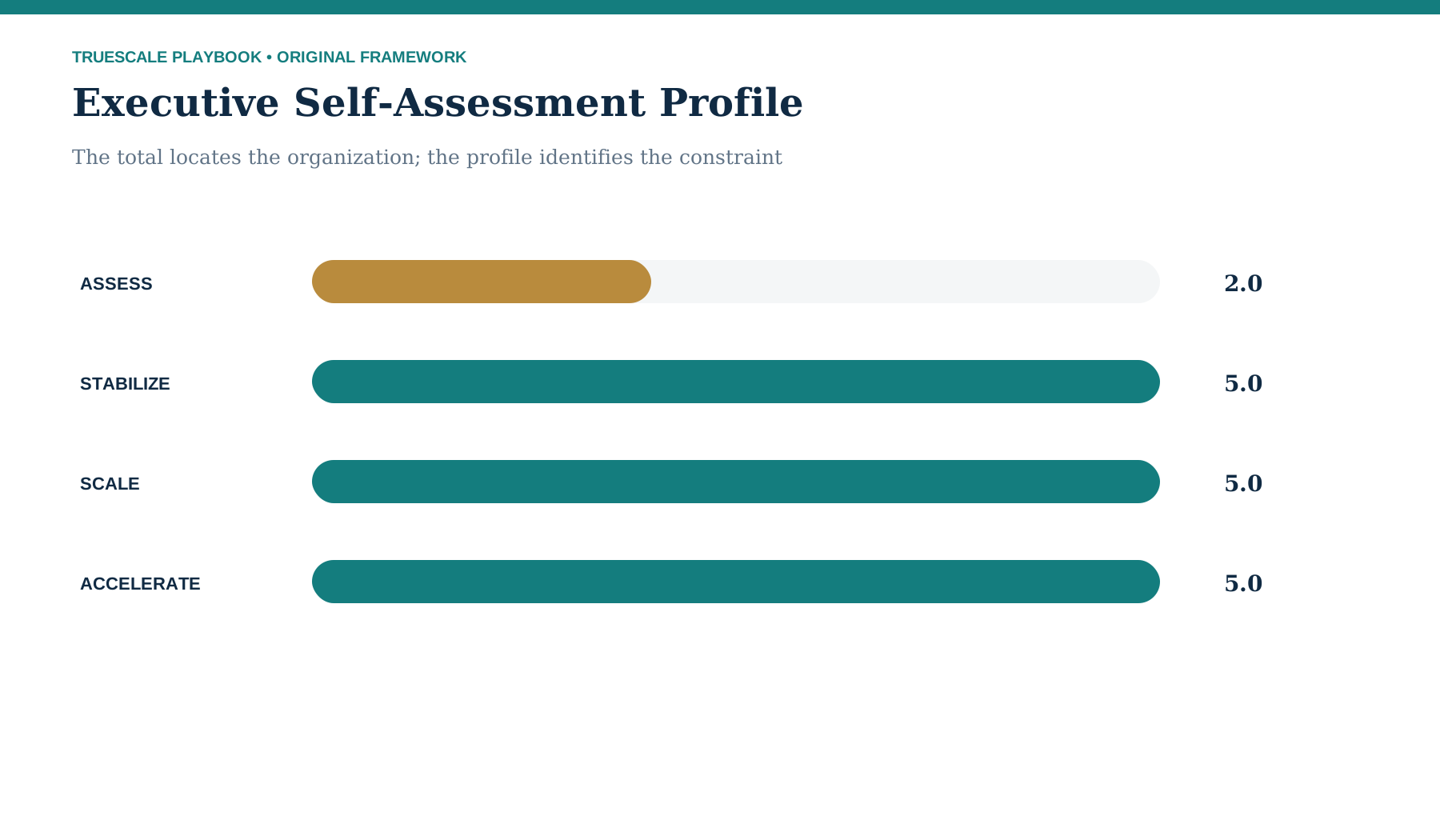
Read the result in this order:
- Review the lowest domain. It often identifies the capability most likely to constrain the next stage of growth.
- Inspect every score of 1. A single critical weakness can create material exposure even when the total is high.
- Compare executive responses. Have executives score independently. Review the median and the full range for each question rather than negotiating an average that hides disagreement. A wide spread may reveal inconsistent systems, uneven visibility, or different standards across functions. If even one executive scores a critical-control item 1, keep a Priority Review warning visible. Do not lower the median-based group stage solely because of that minority response unless the team has approved a separate group rule.
- Consider severity. Customer, compliance, cash, safety, or business-continuity risk can outweigh the arithmetic.
- Test the evidence. If the score depends on one strong team or one leader's intervention, the capability may not be as mature as it appears.
The total tells you where the organization sits. The profile tells you what it needs next. Two companies can score 58 and need completely different work. One may have strong reporting and weak decision rights. The other may have disciplined operations and no readiness for automation. The number is the same. The constraint is not.
Do not average away a serious operating risk.
Interpret each maturity stage
Reactive
The operation depends heavily on effort, proximity, and access to a few people. The immediate priority is to make critical work visible. Choose the workflow, decision, or dependency creating the greatest customer or business risk. Assign an owner, define the minimum standard, and establish a basic review cadence.
Managed
The organization has installed structure, but systems remain uneven or disconnected. Focus on the places where accountability crosses functions, where managers own outcomes without controlling dependencies, and where leaders still act as default tie-breakers. The move forward comes from consistency and integration, not more isolated documentation.
Scalable
The core operation is repeatable and increasingly resilient. The work now is to connect demand, capacity, management capability, and cross-functional performance. Keep improving the system so stability doesn't harden into unnecessary bureaucracy.
Accelerating
The organization is ready to create leverage through data, automation, and AI. Readiness doesn't remove the need for control. Require a clear use case, reliable data, an accountable owner, human review where the risk requires it, and evidence that the change improves the operation.
Self-Sustaining
The organization can adapt its systems, develop leaders, and transfer knowledge without depending on a few people to drive every change. Protect renewal. Review succession, emerging key-person risk, stale measures, and the assumptions that made the current operating model successful.
Convert the score into action
Choose one priority constraint. A useful priority meets three conditions:
- it creates material customer, people, financial, compliance, or continuity risk;
- it influences more than one visible symptom; and
- leaders can name an owner and evidence of progress.
Then write a one-sentence action statement:
We will improve [operating capability] by changing [mechanism], owned by [person], and we will know it is working when [evidence] changes by [review date].
The bracketed structure is a working prompt, not publication copy. Replace it with the actual decision.
Executive working tool
Run the executive scoring discussion
Ask each executive to bring an independent score and one piece of evidence for every answer below 4. Use the meeting to resolve definitions, not to negotiate a more comfortable total.
At the end of the discussion, capture:
- the provisional maturity stage;
- the lowest domain;
- any score of 1 tied to material risk;
- the largest differences between executive responses;
- the priority constraint;
- the executive owner; and
- the evidence and date for review.
Your score gives you a place to start. Chapter 7 shows how to build the leadership infrastructure that makes the next stage possible.
Building Your Leadership Infrastructure
You now have two diagnostic results: a maturity score and at least one estimated source of operational debt.
That's evidence. It isn't a plan.
The temptation at this point is to start fixing things. Resist it. A constraint without an owner, a measure, and a review rhythm is just a complaint with better formatting. Chapter 7 is where you decide what to build so the constraint stops costing you.
Start with the constraint, not the full catalog. A team with unclear decision rights does not need every new meeting, KPI, and management tool at once. It needs the smallest combination that changes who decides, what evidence they use, and when leaders review the result.
Leadership infrastructure is the set of routines, decisions, measures, and management practices that let people lead without reinventing the organization every week.
Infrastructure isn't limited to technology. It includes the way priorities become work, the way decisions move, the way managers coach, the way performance becomes visible, and the way the organization responds when something goes off plan.
When that infrastructure is weak, leaders compensate personally. They add meetings, hold approvals, rewrite work, answer the same questions, and carry context between teams. The business may still move, but it moves through executive effort rather than an operating system.
Most leadership teams don't need a better meeting calendar. They need a system that keeps operating decisions at the center and makes everything else support them. The calendar is a symptom. The decision architecture is the system.
The answer isn't to copy another company's meeting calendar or install a complicated accountability model. Build the smallest leadership system that helps your organization make better decisions, earlier, at the right level.
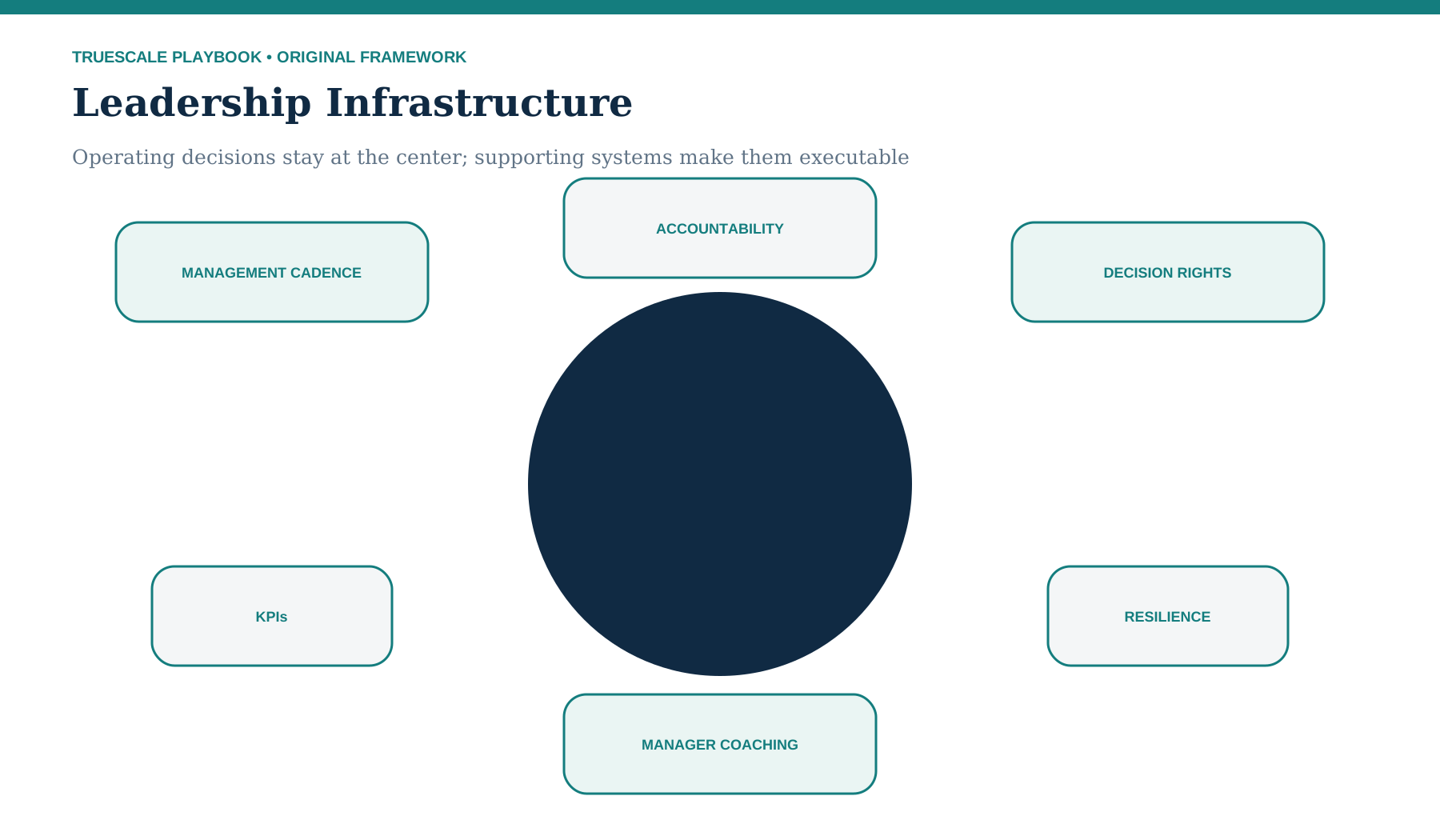
Begin with the work leadership must support
Before you design a cadence, name the work the leadership system has to do. At a minimum, leaders need to set direction, translate priorities, monitor performance, resolve cross-functional issues, allocate resources, develop managers, and protect the organization from material risk.
If those responsibilities aren't clear, meetings become containers for whatever feels urgent. The same topic appears in several forums. Decisions move without an owner. Managers leave with information but no change in the work.
Start by asking five questions:
- Which decisions need a recurring forum?
- Which performance changes require action before the month or quarter ends?
- Which dependencies need more than one function in the room?
- Which issues belong with managers, and which genuinely require executives?
- What leadership work is being displaced by rescue and administration?
The answers tell you what infrastructure to build. The calendar comes later.
Hypothetical scenario - building only what the constraint needs
Consider a hypothetical software company whose leadership team scores well on strategy and data access but poorly on decision rights, operating reviews, and manager authority. Its Operational Debt Ledger shows that eight department leaders spend a combined 24 hours each week resolving customer-credit exceptions. The hours represent recoverable leadership capacity, not automatic cash savings.
The obvious response is to add a weekly exception meeting. That would create visibility, but it would also preserve the dependency. The better first build is a decision rule: managers may approve credits within defined customer, value, and risk thresholds; exceptions outside those boundaries go to one accountable executive with the evidence required for a decision.
The company then gives the existing weekly operating review one additional job. Leaders review the number of exceptions, the percentage decided at the manager level, the reasons issues still escalate, and any customer or financial harm. They do not review every case. Managers receive coaching on the judgments that fall inside their new authority, and the executive owner updates the threshold when repeated exceptions reveal a policy gap.
| Infrastructure choice | Completed hypothetical decision |
|---|---|
| Priority constraint | Routine customer-credit decisions repeatedly wait for senior approval. |
| Accountable owner | Chief operating officer owns the decision rule and its results. |
| Authority boundary | Managers decide within approved customer, value, and risk thresholds. |
| Review measure | Escalation volume, manager-level decision rate, decision time, and harmful exceptions. |
| Operating cadence | Review patterns in the existing weekly operating meeting for eight weeks. |
| Adjustment rule | Change the threshold or coaching when evidence shows repeated misclassification or material risk. |
This is the tradeoff leaders have to manage. Wider authority may improve speed and recover executive capacity, but the organization should not delegate beyond the evidence, control, or manager capability it can support. The goal is not maximum delegation. It is reliable judgment at the lowest appropriate level.
Design a management cadence with distinct jobs
A management cadence should reduce coordination cost, not institutionalize it. Each forum needs a purpose, the minimum necessary participants, a clear input, and an expected output.
Daily or near-term operating check
Use a short operating check when the work changes quickly enough to require frequent coordination. The purpose is to identify material blockers, workload shifts, service risk, and actions due before the next check.
This is not the place for long problem-solving or status reports everyone can read elsewhere. If an issue needs deeper work, assign an owner and move it to the right forum.
Weekly team review
The weekly review connects current performance with management action. Review a small set of measures, the exceptions that matter, commitments from the prior week, capacity concerns, and decisions the team can make now.
The meeting should answer: What changed? Why does it matter? What are we doing? Who owns it? When will we look again?
Executive operating review
The executive operating review manages the business across functions. It should focus on enterprise measures, material variation, cross-functional constraints, resource tradeoffs, customer and workforce risk, and decisions that exceed one team's authority.
Don't use the meeting to hear every department report. Give leaders the information in advance. Use the time to interpret, decide, and assign follow-through.
Periodic business review and planning
Monthly or quarterly forums should look beyond immediate exceptions. Review trends, assumptions, strategic priorities, investment choices, capability gaps, and changes in the operating environment.
The frequency should fit the business. A label such as monthly or quarterly is less important than the decision cycle it supports.
Give every meeting an operating contract
Executive working tool
For each recurring forum, define:
- Purpose: the management job this meeting performs;
- Owner: the person accountable for the agenda and outcome;
- Participants: only the roles needed to interpret, decide, or execute;
- Inputs: the measures, issues, or pre-reading required;
- Decisions: what the forum can decide and what must escalate;
- Outputs: actions, owners, dates, and updated decisions;
- Cadence: how often the work requires the forum; and
- Retirement test: the condition under which the meeting should change or stop.
That last field matters. Meetings accumulate because starting one is easy and ending one feels risky. If a forum no longer improves a decision, change it or remove it.
Make accountability executable
Accountability often fails because leaders name an owner without changing the conditions around the work. The owner receives the target but not the authority, information, capacity, or cooperation needed to reach it.
I've watched more accountability initiatives fail on the second condition than the first. Naming an owner is easy. Giving that owner authority over the work that determines the result is harder, because it usually means someone else has to give something up. If the owner can't influence the dependency, you haven't assigned accountability. You've assigned blame with a longer timeline.
For every critical outcome, define five things:
- The result. State the outcome in observable terms.
- The owner. Name one person accountable for integrating the work.
- The authority boundary. Clarify what the owner can decide without further approval.
- The dependencies. Identify the people, systems, and inputs outside the owner's direct control.
- The review path. Define the measure, cadence, and escalation threshold.
One owner doesn't mean one person does all the work. It means one person is responsible for making the result coherent across contributors.
If the same outcome has three owners, it usually has none. If the owner has no authority over a critical dependency, that dependency belongs in the operating design, not in a footnote.
Define decision rights before the meeting
Decision delay is often treated as a collaboration problem. It is usually a design problem. The group doesn't know who decides, what input is required, which criteria matter, or when the decision has to be made.
Use a short decision brief for consequential or recurring choices:
Executive working tool
| Field | Question to answer |
|---|---|
| Decision | What exactly must be decided? |
| Decider | Who has final authority? |
| Required input | Which roles or facts must inform the choice? |
| Criteria | What outcomes, risks, and constraints will guide the decision? |
| Deadline | When does delay become more costly than an imperfect choice? |
| Escalation | What condition moves the decision to a higher level? |
| Review | When will the organization evaluate the result? |
The brief doesn't make the decision easy. It makes the decision visible. It also lets leaders review judgment after the fact instead of holding every choice in advance.
Build KPIs around decisions
The KPI system should tell leaders where to act, not simply describe the business. Start with the decision, then choose the measure.
A useful KPI needs:
- a clear name and business question;
- an exact definition and scope;
- a trusted data source;
- an owner;
- a review cadence;
- a threshold or pattern that requires attention; and
- a response when that condition appears.
Pair lagging results with leading operating conditions. Revenue retention may be the lagging result. Resolution time, repeat contacts, usage changes, or unresolved service failures may give the team an earlier view. The right leading measure depends on the business and should be tested rather than assumed.
I would rather see a leadership team use six well-defined measures than present forty numbers that require a tour guide. Every measure should earn its place by improving a decision.
Use a KPI contract
Executive working tool
For each executive KPI, complete this sentence:
We review [measure], defined as [definition], from [source], owned by [person], every [cadence]. When [threshold or pattern] occurs, [owner] will [response].
If the team can't complete the sentence, the measure isn't ready to manage performance.
Turn manager coaching into operating work
Managers don't develop because the organization schedules a training event. They develop when the role has clear expectations, they receive feedback on real decisions, and they have a consistent place to work through team and system issues.
A useful coaching conversation covers four areas:
- Outcomes: What result is the team accountable for, and what changed?
- People: Who needs direction, feedback, recognition, or a clearer expectation?
- System: What recurring obstacle is forcing the manager or team to compensate?
- Development: Which leadership behavior or decision does the manager need to practice next?
The cadence should reflect the manager's experience, the pace of the work, and the level of change. New managers usually need more frequent observation and feedback than experienced leaders in stable roles.
Don't let every coaching conversation become a project-status meeting. If the manager only reports what the team did, the organization loses the chance to improve how the manager leads.
Protect resilience and continuity
Leadership infrastructure has to work when the usual people aren't available. That requires more than a succession chart.
Review resilience at three levels:
- Role coverage: Who can make the essential decisions when the role owner is absent?
- Knowledge coverage: Where are the standards, context, relationships, and exception logic held?
- System coverage: Which access, data, vendors, or approvals could stop the work?
For each critical role or workflow, identify a primary owner, a credible backup, the knowledge that must transfer, and the decisions that cannot wait. Test the coverage through planned absence, rotation, simulation, or structured handoff. A backup that has never performed the work is an intention, not resilience.
The test I use is simple: if the owner of this workflow were unreachable for two weeks starting Monday, what would stop? The answer tells you where the real concentration risk sits. It is rarely the role that appears on the succession chart.
Install the system in sequence
Leadership teams sometimes launch a new scorecard, meeting cadence, accountability matrix, and manager program at the same time. The organization then spends more energy learning the management system than improving the work.
Sequence the build:
First 30 days - clarify
- identify the priority operating constraint;
- map the decisions and dependencies around it;
- name the accountable owner;
- define the few measures needed to see it; and
- remove one forum or report that no longer helps.
Days 31-60 - stabilize
- establish the operating review for the constraint;
- define thresholds, escalation, and follow-through;
- give managers the authority and information they need; and
- document the minimum process and exception path.
Days 61-90 - build capability
- review whether the mechanism changed;
- coach managers on the decisions the system now expects them to make;
- address cross-functional gaps;
- test continuity when a key person is unavailable; and
- decide what to scale, revise, or stop.
The sequence is illustrative. The organization may need a different pace. What matters is that the system changes behavior before the team adds another layer.
Executive working tool
Is your leadership system doing its job?
- Which recurring meeting produces the most important decisions?
- Which meeting could disappear without changing the work?
- Which owner carries accountability without enough authority?
- Which KPI tells you what happened but not what to do?
- Which manager spends the most time compensating for a system weakness?
- Which critical role lacks credible coverage?
Choose one part of the leadership infrastructure to repair. Define the behavior that should change, assign an owner, and review the evidence within the next operating cycle.
AI and the Future of Operational Leadership
AI creates leverage only when the organization is ready to own the result.
Building stronger leadership infrastructure does not make AI the automatic next step. It gives you a better way to decide whether AI can improve a specific operating capability. Sometimes the right next move is better ownership, cleaner data, or a more stable process. Sometimes a bounded AI use case can add useful leverage. The decision starts with the capability, not the tool.
AI has moved into everyday operating work. Teams use it to find information, draft content, classify requests, summarize interactions, support forecasts, review quality, route work, and automate routine tasks. The opportunity is real.
So is the temptation to move too quickly.
Leaders can buy a tool before they have defined the problem, connect it to unstable data, or place it inside a process nobody fully understands. The pilot may look fast because the organization measures activity instead of the operating result. Then the tool moves into production, and the unresolved work becomes harder to see.
I approach AI the same way I approach any operating change: start with the decision or workflow, understand the current system, define the value, name the owner, and build controls that match the risk.
AI isn't a separate strategy. It is a capability inside the operating model.
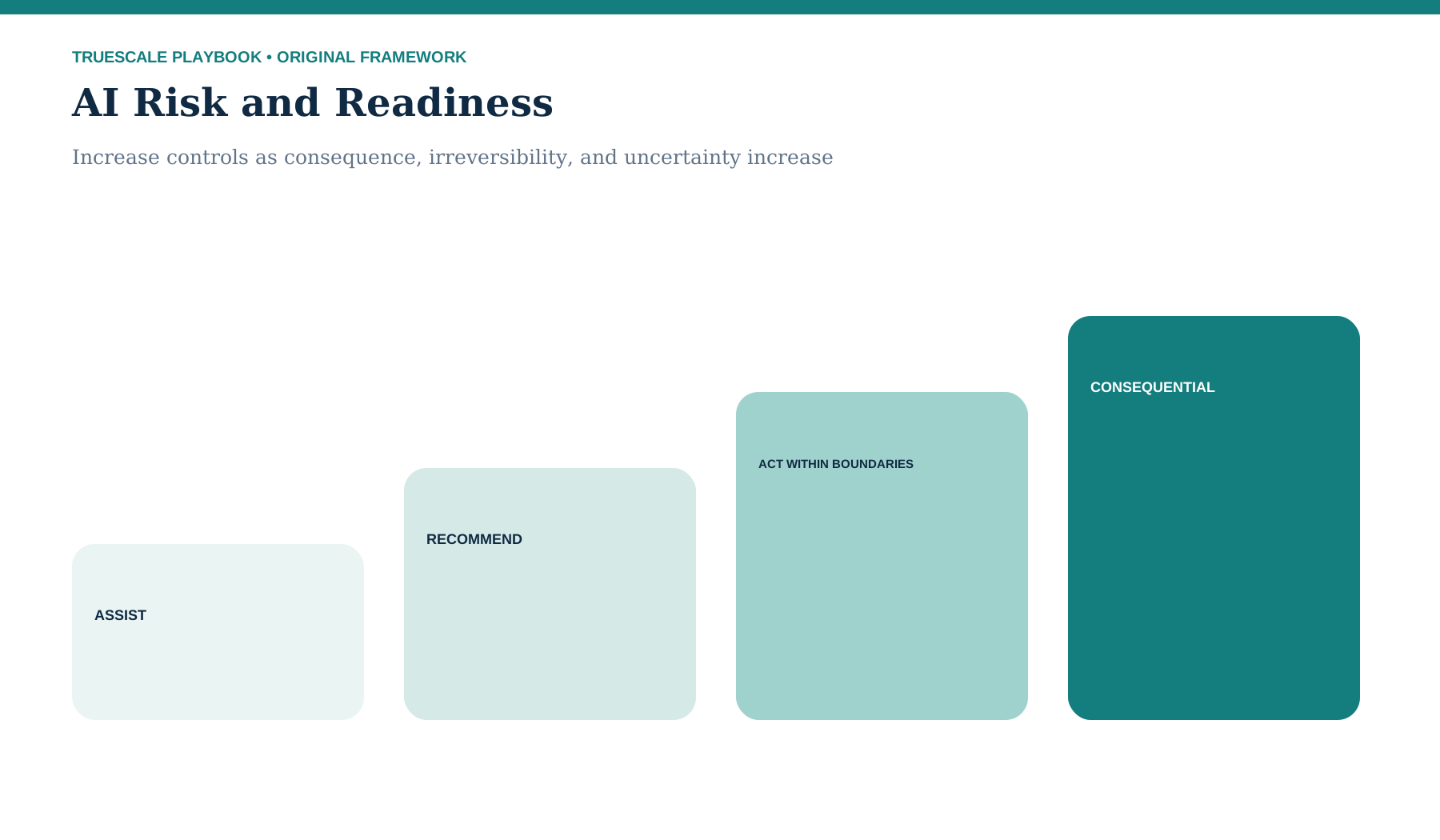
Begin with the operating problem
Don't start with, Where can we use AI? That question produces a long list of possibilities and very little priority.
Start with the work:
- Where does a high volume of routine effort create delay or cost?
- Where do people spend time finding, sorting, summarizing, or transferring information?
- Which decisions would improve with earlier or better evidence?
- Where does quality vary because reviewers cannot examine enough work?
- Which customer or employee interactions require judgment that should remain human?
The use case should name a measurable problem. "Deploy an AI assistant" is a tool decision. "Reduce the time managers spend locating approved policy guidance while maintaining answer accuracy and access controls" is an operating use case.
That difference changes the pilot, the measures, and the accountability.
Match the use case to the level of risk
AI can support work in several ways. The human role should become more explicit as the consequence of error increases.
Assist
The system helps a person draft, summarize, retrieve, or organize information. A person remains responsible for the final work. Examples may include meeting summaries, knowledge search, first drafts, or administrative support.
Recommend
The system proposes a classification, priority, forecast, or next action. A person reviews the recommendation and makes the consequential decision. Examples may include queue prioritization, quality-review targeting, or planning support.
Act within boundaries
The system completes a defined task when inputs, rules, exceptions, and monitoring are clear. Examples may include low-risk routing, data movement, standard notifications, or approved workflow steps.
Influence consequential decisions
The system affects employment, eligibility, health, safety, credit, access, pricing, or another material outcome. These use cases require stronger legal, risk, data, testing, documentation, and human-review controls. Some may not be appropriate for automation at all.
The classification is not about how sophisticated the technology appears. It is about the consequence of being wrong, the reversibility of the action, and the organization's ability to detect and correct the error.
Most AI failures I've seen discussed in operating reviews weren't model failures. They were classification failures. A team treated a recommend-level use case as if it were an assist-level task, and nobody had defined who reviewed the output or what happened when it was wrong. The technology worked. The operating design didn't.
Use the TrueScale AI readiness screen
Executive working tool
Before approving a pilot, answer seven questions:
- Problem: What operating problem or decision are we improving?
- Baseline: How does the work perform today?
- Process: Is the current workflow stable enough to change or automate?
- Data: Do we understand the source, quality, permission, sensitivity, and limits of the data?
- Risk: What happens when the system is wrong, unavailable, biased, manipulated, or misunderstood?
- Ownership: Who is accountable for the business result, the technology, the data, and the control environment?
- Evidence: What result will justify expansion, revision, or shutdown?
If the team cannot answer the first two questions, the use case isn't ready. If it cannot answer the risk and ownership questions, the use case isn't governable.
Keep human accountability visible
"Human in the loop" can sound reassuring while leaving responsibility unclear. A person clicking approve on every output isn't meaningful oversight if that person lacks time, context, authority, or a way to challenge the system.
Define the human role precisely:
- What must the reviewer examine?
- What evidence accompanies the recommendation?
- When can the reviewer override it?
- What decisions may never be automated?
- How are overrides, disagreements, and errors recorded?
- Who owns the outcome after the review?
The organization remains accountable for the operating result even when a vendor or model performs part of the work. Accountability cannot be outsourced to the tool.
Build controls around the use case
Responsible implementation requires controls that fit the actual risk. Not every use case needs the same level of governance, but every use case needs an owner and a defined control path.
Data and privacy
Know what information enters the system, where it goes, how long it remains, who can access it, and whether the intended use matches the organization's commitments and legal obligations. Sensitive customer, employee, health, financial, or proprietary information requires deliberate handling. Convenience is not permission.
Reliability and quality
Test the system against representative work, difficult cases, and known failure conditions. Define acceptable performance and the situations that require human review. Generative output should not be treated as correct because it is fluent.
Fairness and employment impact
When AI influences hiring, promotion, pay, performance, scheduling, or termination, leaders need to consider whether the process creates unlawful or unjustified barriers. Review job relevance, accessibility, accommodation, data quality, selection outcomes, and vendor claims. The legal obligation remains with the employer even when software supports the decision.
Security and abuse
Consider unauthorized access, prompt manipulation, data leakage, model or vendor compromise, and inappropriate use by insiders. Define access, logging, escalation, and incident response before the tool reaches sensitive work.
Transparency and communication
Decide what employees, customers, applicants, and partners should know about the role AI plays. Avoid claims the evidence cannot support. If the system materially shapes an interaction or decision, the communication should match the context, risk, and applicable requirements.
Vendor and change management
Understand what the vendor can change, what data it uses, how performance is monitored, how incidents are handled, and how the organization can exit. Model behavior, pricing, integrations, and terms can change. The operating plan has to survive more than the initial demo.
Measure business value without inflating it
AI pilots often measure output: summaries created, messages drafted, cases classified, or minutes saved. Those measures show activity. They do not prove business value.
Connect the pilot to an operating result:
- cycle time;
- cost per completed unit;
- quality or error rate;
- customer resolution or experience;
- employee capacity;
- forecast usefulness;
- risk detection; or
- decision speed and consistency.
Use a baseline and include the cost of licenses, implementation, integration, review, monitoring, error correction, and change management. If the pilot recovers time, state how the organization will use the capacity. Don't present theoretical hours as cash savings unless an expense actually changes.
Run a bounded pilot
A strong pilot is small enough to control and real enough to teach the organization something useful.
Executive working tool
Define a pilot contract:
| Field | Pilot decision |
|---|---|
| Use case | The exact workflow or decision in scope |
| Hypothesis | The operating result expected to improve |
| Baseline | Current performance and measurement method |
| Population | Users, customers, data, and work included or excluded |
| Human role | Required review, authority, and override path |
| Risk controls | Privacy, security, fairness, quality, and escalation controls |
| Success threshold | Evidence required to expand |
| Stop condition | Error, harm, drift, or failure that pauses the pilot |
| Owner | Executive accountable for the business result |
| Review date | When the decision to expand, revise, or stop will be made |
Do not let the pilot become permanent through neglect. End it with a decision.
Hypothetical scenario - a bounded knowledge pilot
Imagine a customer-operations team whose managers spend time searching approved policies before they can answer frontline questions. The problem is narrow and measurable, but the company is not ready to let an AI system answer customers or make policy decisions.
The team proposes a four-week internal pilot for twelve trained managers. The system may retrieve passages from an approved policy library and draft an internal response. It cannot send a message, change an account, approve an exception, or use material outside that library. A manager must compare every draft with the cited policy and remains accountable for the answer.
The numbers below are hypothetical assumptions for the teaching example, not benchmarks or claimed results.
| Pilot field | Completed hypothetical decision |
|---|---|
| Operating problem | Managers spend a median of 12 minutes locating approved guidance for an eligible policy question. |
| Hypothesis | The pilot will reduce median search-and-draft time to 8 minutes or less without reducing review quality. |
| Population | Twelve trained managers; approved policy questions only; no customer-facing output or consequential decisions. |
| Data boundary | Current approved policy library; no unrestricted web content; no sensitive case details beyond the minimum needed for retrieval. |
| Human role | A manager verifies the cited source, edits the draft, and owns the final internal guidance. |
| Quality measure | A qualified reviewer evaluates a defined sample using the same accuracy and policy-completeness criteria used at baseline. |
| Stop condition | Pause for unsupported guidance, unauthorized data exposure, repeated missing citations, or a material decline in reviewed quality. |
| Decision date | At four weeks, expand, revise, pause, or stop based on time, quality, incidents, overrides, user feedback, and full pilot cost. |
The tradeoff is deliberate. Requiring review limits the theoretical speed gain, but it keeps authority with the manager while the team learns where the system fails. If the pilot only saves theoretical minutes and the recovered capacity has no planned use, the business case remains incomplete. If quality declines or the control path fails, the team stops. A successful demo is not the same as an operating capability.
Govern AI as operating work
The National Institute of Standards and Technology's voluntary AI Risk Management Framework organizes AI risk management around four functions: Govern, Map, Measure, and Manage. That structure reinforces an important operating principle: governance, context, measurement, and response have to work together across the AI lifecycle. The framework is being revised, so leaders should verify the current version and any sector-specific requirements before relying on it.
For executive teams, the practical governance rhythm can be straightforward:
- maintain an inventory of active and proposed use cases;
- assign a business owner, technical owner, and risk owner where appropriate;
- classify the consequence and reversibility of error;
- approve data access and human-review requirements;
- review performance, incidents, overrides, and user feedback;
- reassess when the model, vendor, workflow, data, law, or business context changes; and
- retire systems that no longer produce acceptable value or control.
Governance should make responsible use easier to execute. It should not become a committee that discusses risk without owning decisions.
A 90-day responsible AI implementation path
Days 1-30 - choose and baseline
- inventory current AI use, including informal tools already in the work;
- select one measurable, bounded use case;
- document the current process, data, owner, baseline, and risk level;
- define human review and stop conditions; and
- confirm legal, privacy, security, and vendor requirements.
Days 31-60 - test and observe
- test representative and difficult cases;
- train users on the purpose, limits, and escalation path;
- measure quality, time, cost, overrides, and unexpected effects;
- review incidents and user feedback; and
- adjust the process, not only the prompt or model.
Days 61-90 - decide
- compare results with the baseline;
- confirm that the control environment works in practice;
- calculate direct cost, recovered capacity, and risk separately;
- decide whether to expand, revise, pause, or stop; and
- assign the ongoing monitoring cadence and owner.
Executive working tool
Is the organization ready to own the result?
- Which AI use cases are already in the operation, including informal use?
- Which one begins with the clearest operating problem?
- Where would an error create a material customer, employee, legal, or business consequence?
- Who owns the result after the tool produces an output?
- What evidence would justify expansion?
- What condition would make you stop?
AI can increase speed, capacity, and insight. It can also make weak assumptions travel faster. The operating leader's job is to know the difference.
AI doesn't change the leadership question. It changes the speed at which the answer matters. The organizations that use these tools well are the ones that already know who owns the outcome, what evidence counts, and when a human has to decide. Those are the same conditions that made the operating model work before AI arrived.
The tools are new. The accountability isn't.
Final Chapter
Where Does Your Organization Go From Here
You don't have to fix everything. You do have to choose what the organization must be able to carry next.
You've now looked at why growing companies break, the five stages of operational maturity, the TrueScale Method™, the warning signs of strain, the cost of operational debt, the Executive Self-Assessment, leadership infrastructure, and responsible AI implementation.
The frameworks matter only if they change a decision.
You may have found several weaknesses. That is normal. Growing organizations rarely have one clean operating problem. They have a set of connected symptoms created by a smaller number of underlying constraints.
Your next step is to choose the constraint that matters now.
Before you move on, write down four commitments: one priority constraint, one accountable owner, one measurable operating change, and one date when the leadership team will review the evidence. If those four items are unclear, the organization has not made a decision yet.
Apply the Playbook independently
You can use the Playbook without hiring an advisor or launching a transformation program. Start with one operating issue and follow the Method.
Assess the current condition
Use evidence from recent work. Review the warning signs and complete the Executive Self-Assessment. Compare leadership responses. Trace one important workflow across teams. Identify where work waits, returns, escalates, or depends on one person.
Name the priority constraint in plain language. If the statement could apply to any company, it isn't specific enough.
Stabilize the constraint
Define the owner, measure, minimum process, authority boundary, and escalation path. Protect the customer and the core operation while the system changes. Remove unnecessary activity before adding new infrastructure.
The immediate objective is a reliable operating floor. The team should be able to see the work and act without constant rescue.
Scale the capability
Once the new behavior holds, make it teachable and repeatable. Build the manager practice, onboarding, knowledge ownership, capacity planning, cross-functional agreements, and resilience the next stage requires.
Don't scale a workaround. Scale the capability that removed the dependency.
Accelerate what is ready
Use automation, AI, and continuous improvement where the process is understood, the data is usable, the owner is clear, and the result can be measured. Keep human accountability visible. Reassess when conditions change.
Then begin again. The Method is a management cycle, not a one-time project.
Your next 30 days
Executive working tool
Use the next month to turn the Playbook into one operating change.
Week One - establish the evidence
- complete the Executive Self-Assessment independently across the leadership team;
- mark the warning signs supported by current evidence;
- identify the lowest domain and any material score of 1; and
- choose one workflow, decision, or dependency to examine.
Week Two - make the mechanism visible
- trace how the work moves;
- identify the owner, handoffs, measures, and exceptions;
- estimate the direct cost, recovered capacity, or risk created; and
- agree on the priority constraint.
Week Three - install the minimum change
- define the result and owner;
- clarify the decision boundary and escalation path;
- choose the few measures the team will review; and
- remove a workaround, report, meeting, or approval that no longer helps.
Week Four - review behavior
- look for evidence that the mechanism changed;
- ask managers and employees what still requires compensation;
- adjust the system; and
- set the next review date.
The goal isn't to complete a list. It is to change one operating behavior in a way the organization can sustain.
Know when outside help is useful
Some teams can do this work independently. Others benefit from an external view because the evidence crosses functions, the leadership team disagrees about the constraint, or the people running the operation don't have the capacity to diagnose it while carrying current demand.
Outside support may be useful when:
- the same issues recur despite repeated internal action;
- the founder or executive team is part of the decision bottleneck;
- no one owns the end-to-end operating problem;
- customer, compliance, workforce, or continuity risk requires a faster response;
- a major growth event will add volume or complexity before the current system is ready; or
- leaders need an independent current-state view before committing to a larger investment.
The decision to seek support should begin with the work, not with a sales process.
The TrueScale Assessment
The TrueScale Assessment™ is the professional next step for leaders who want a structured, independent view of the operating system before deciding what to change.
The assessment is designed to examine the current state, identify material operating and key-person risks, name the constraints most likely to limit growth, and provide sequenced executive recommendations. The exact scope should fit the organization's stage, operating model, and immediate decisions.
It is not a promise to fix every issue, a substitute for management ownership, or an automatic commitment to a longer engagement. Its value is clarity: a grounded view of what is happening, why it matters, and what should come first.
If the Playbook has already given your team enough direction, use it. Choose the constraint, assign ownership, and begin. If the team needs an independent assessment, a voluntary discovery conversation can determine whether the TrueScale Assessment™ is appropriate.
Keep building the system
Growing companies don't become easier to lead because complexity disappears. They become more capable because the leadership system can carry more of that complexity without losing clarity, accountability, or judgment.
That system is never finished. Strategy changes. Customers change. Leaders move. Technology creates new possibilities and new risks. The work is to keep the operating model aligned with what the business is becoming.
Assess what is true. Stabilize what is fragile. Scale what must become repeatable. Accelerate what is ready.
Then reassess.
Because the only thing that scales is the system.
Notes and Sources
Chapter Five
- All financial calculations are explicitly illustrative and use stated assumptions. They are not presented as benchmarks, research findings, client results, or promises of savings.
- The chapter does not use generic turnover-cost, onboarding-time, productivity-loss, or churn benchmarks. Organizations should replace the sample inputs with internal data and document attribution, overlap, and uncertainty.
- Recovered capacity, hard savings, and risk avoided are treated as separate categories to reduce overstatement.
Chapter Six
- The twenty-question Executive Self-Assessment is a proprietary management screen aligned with the approved TrueScale framework. It has not been statistically validated.
- The five score bands divide the possible 20-100 range for practical interpretation. They are not linked to researched failure probabilities or financial outcomes.
- Individual and group results should be used as structured input for leadership discussion, not as an audit, a prediction, or a substitute for professional judgment.
Chapter Eight
- National Institute of Standards and Technology, Artificial Intelligence Risk Management Framework 1.0, NIST AI 100-1, January 26, 2023. Retrieved October 20, 2026: NIST AI RMF 1.0 publication
- National Institute of Standards and Technology, Artificial Intelligence Risk Management Framework Generative Artificial Intelligence Profile, NIST AI 600-1, July 26, 2024. Retrieved October 20, 2026: NIST Generative AI Profile
- NIST AI Risk Management Framework resources and current revision status. Retrieved October 20, 2026: NIST AI Risk Management Framework resources
- U.S. Equal Employment Opportunity Commission and U.S. Department of Justice, technical assistance on disability discrimination and employers' use of AI tools, May 12, 2022. Retrieved October 20, 2026: EEOC and DOJ technical assistance
- U.S. Equal Employment Opportunity Commission, Uniform Guidelines questions and answers on employee selection procedures and adverse impact. Retrieved October 20, 2026: EEOC Uniform Guidelines questions and answers
- Federal Trade Commission, guidance on privacy and confidentiality commitments involving AI, January 9, 2024. Retrieved October 20, 2026: FTC privacy and confidentiality guidance
Optional next step
Take the operating question into your leadership conversation.
The book stands on its own. If outside perspective would create useful clarity, the advisory pathway is separate and optional.
Start a business conversation